


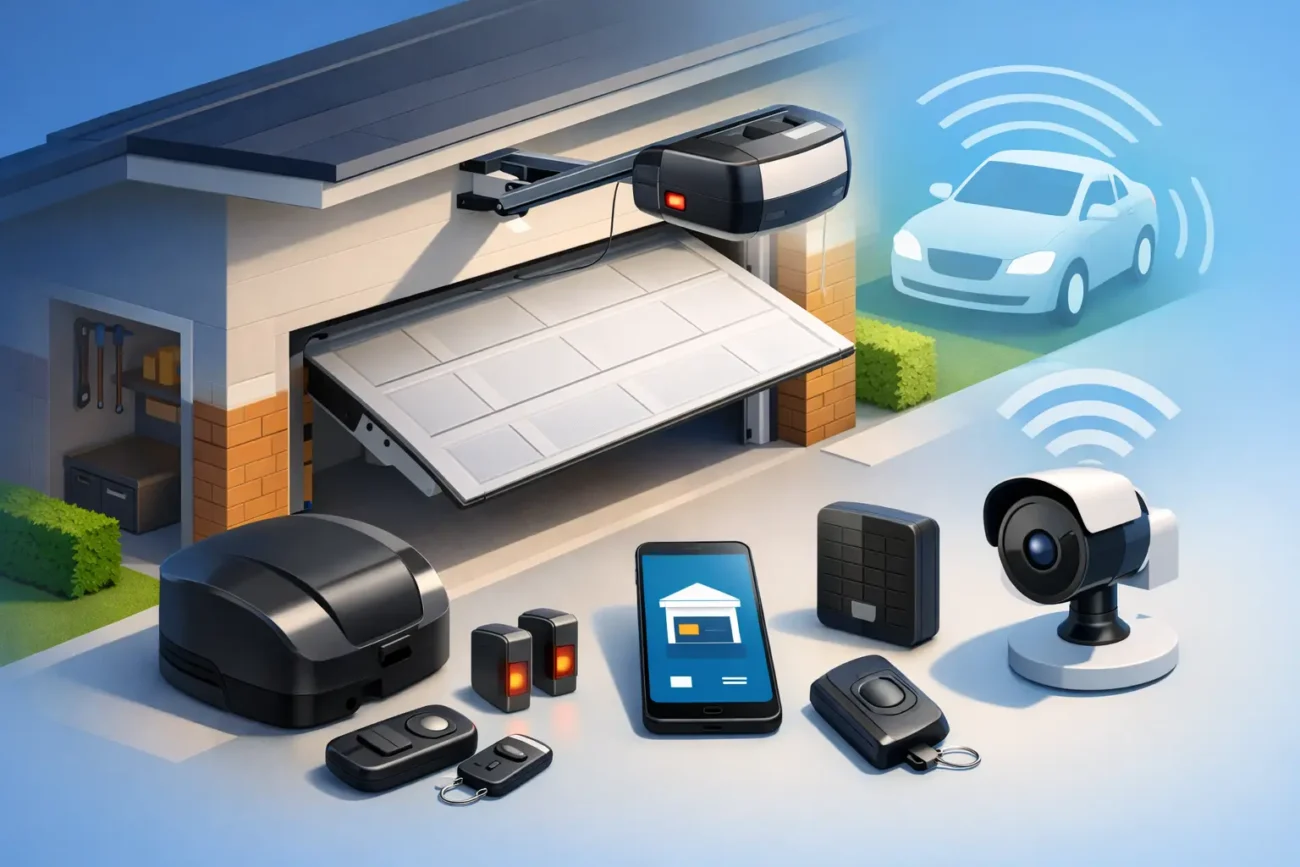
If your garage door only opens when everything lines up perfectly, the weather is dry, and someone gives it a firm shove, it is probably time to look at a proper garage door automation kit. The right kit does more than add convenience. It improves day-to-day access, reduces strain on the door, and helps keep the system safe and reliable over the long term.
That said, not every automation kit suits every garage door. This is where many buyers get caught out. A product may look right on paper, but if it does not match the door type, weight, travel, or control setup, you can end up with poor performance, nuisance faults, or a shortened service life.
What a garage door automation kit actually includes
In simple terms, a garage door automation kit is the hardware and control package that turns a manual garage door into an electrically operated one. Depending on the model and the door it is designed for, that usually means a motor unit, drive rail or operator arm, control electronics, remote transmitters, and safety components such as photocells or obstacle detection.
Some kits are more complete than others. One may include everything needed for a straightforward domestic installation, while another may require separate accessories for safety edges, external release, key switch control, or smartphone operation. That matters when you are comparing price, because a cheaper starter kit can quickly stop looking cheap once the essential extras are added.
Start with the door, not the motor
The most common mistake is shopping by motor brand or advertised lifting force before checking the door itself. The better approach is to work backwards from the existing setup.
An up-and-over garage door has very different automation requirements from a sectional door. A roller garage door needs a different operator arrangement again. Even within those categories, spring condition, door balance, headroom, and track configuration can affect which kit is suitable.
A well-balanced door puts less strain on the operator. A heavy door with tired springs does the opposite. If the door is already hard to move by hand, fitting automation will not fix the underlying problem. It often makes it more obvious. Before fitting any kit, the door should be mechanically sound, correctly aligned, and operating smoothly in manual mode.
How much power do you really need?
Motor force is important, but more is not always better. A unit that is underpowered may struggle in cold weather or wear out early. A unit that is oversized for the application can be unnecessarily expensive and may not deliver any practical benefit in normal domestic use.
What matters more is matching the operator to the door size, door weight, opening frequency, and site conditions. A single garage door used twice a day has different demands from a larger door on a busy outbuilding, workshop, or mixed-use property. Duty cycle matters. So does the door’s travel length. Some operators are built for occasional use, while others are designed for more frequent opening and closing.
If you are replacing an existing operator, check the old unit details carefully, but do not assume a like-for-like replacement is always best. Older systems may have been oversized to compensate for door drag or poor balancing, or undersized because the original installer worked with what was available.
Garage door automation kit options by door type
Up-and-over doors
These are common across the UK and can often be automated with a boom-and-rail operator. Canopy and retractable versions differ, so the correct arm arrangement and geometry matter. Some doors also need a conversion arm or additional linkage to achieve smooth travel.
Sectional garage doors
Sectional doors are generally well suited to automation, especially where the tracks and springing are in good condition. The key points are door height, headroom, and the operator’s travel capacity. Noise can also be a factor if the garage is attached to the house.
Roller garage doors
Roller doors are usually automated with a tubular motor or a dedicated roller shutter operator, depending on the design. Here the axle size, curtain weight, end locks, and safety setup all need checking. It is less about a generic kit and more about a matched operator package.
Safety is not an extra
Too many buyers still treat safety devices as optional add-ons. They are not. Any powered garage door needs suitable safety features, both for compliance and for common sense.
At minimum, the system should detect obstruction and react correctly. Depending on the door type and installation environment, that may involve force limitation, photocells, safety edges, or a combination of these. Manual release is just as important. In a power cut, the user needs a safe way to disengage the motor and operate the door.
This is particularly relevant for garages with no secondary entrance. If the only way in is through the garage door, an external emergency release is usually essential. It is a simple detail, but one that is often missed until the first mains failure.
Controls, access, and day-to-day use
For some buyers, a pair of remote handsets is enough. For others, access control is a bigger part of the decision. You may want a wall-mounted push button, keypad entry, courtesy lighting, app control, or integration with wider gate and access systems.
The right setup depends on who uses the door and how often. A domestic customer may care most about quiet running and easy remote programming. An installer working on a mixed-use site may need more flexible control options and dependable spare parts support. A facilities team may want standardised transmitters across multiple access points.
This is where choosing a known automation platform can save time later. If remotes, receivers, control boards, or safety devices need replacing down the line, recognised systems are generally easier to support than obscure one-off kits.
What matters most for reliability
A garage door operator is only as reliable as the full system around it. Build quality in the motor and controls matters, but so do the parts people often ignore – brackets, rails, limit settings, safety devices, and the condition of the door itself.
Good installation also makes a major difference. Poorly set travel limits, loose fixings, badly positioned photocells, or incorrect force settings can cause repeated call-backs on an otherwise decent product. That is why trade buyers tend to focus on serviceability as much as headline features.
Availability of spare parts matters too. Belts, gears, control boards, capacitors, encoders, and transmitters do not last forever. If you cannot identify or source replacements quickly, a simple fault becomes a longer outage than it needs to be. For homeowners that is inconvenient. For commercial or high-use sites, it can affect security and access.
When a kit is not the full answer
There are situations where a garage door automation kit is not the right fix on its own. If the door is damaged, the springs are failing, the tracks are worn, or the structure has shifted, automation may only add stress to an already compromised system.
Likewise, if you are dealing with an older installation that has had multiple repairs over the years, compatibility can become an issue. New controls may not speak properly to old accessories. Safety upgrades may be needed to bring the installation up to current expectations. In those cases, a partial replacement can end up costing more than a properly planned upgrade.
This is where technical support is worth more than guesswork. A clear photo of the door, operator, arm arrangement, control panel, or data plate can often save a lot of wasted time and incorrect ordering. For buyers who are not sure what they have, that practical part-identification support matters just as much as stock availability.
Choosing a supplier, not just a product
A good automation kit is one thing. Getting the right one, with the right accessories, is another. For installers and maintenance teams, speed and accuracy matter because jobs stall when parts are wrong. For end users, the real value is knowing someone can help if the specification is unclear.
That is why specialist supply tends to beat generic retail when automation is involved. You are not just buying a motor in a box. You are buying compatibility, support, and the ability to get the system back up and running when a component fails.
At Door Spares UK Ltd, that practical approach is a big part of the service. If a customer knows the exact part number, fine. If they only have a photo and a rough description, that can still be enough to point them in the right direction.
The best buying decision is rarely the cheapest kit on the page. It is the one that matches the door properly, includes the safety and control features you actually need, and can still be supported years after it is fitted. Get that right, and the door stops being a daily frustration and starts doing what it should – opening reliably, safely, and without fuss.


Leave a comment