


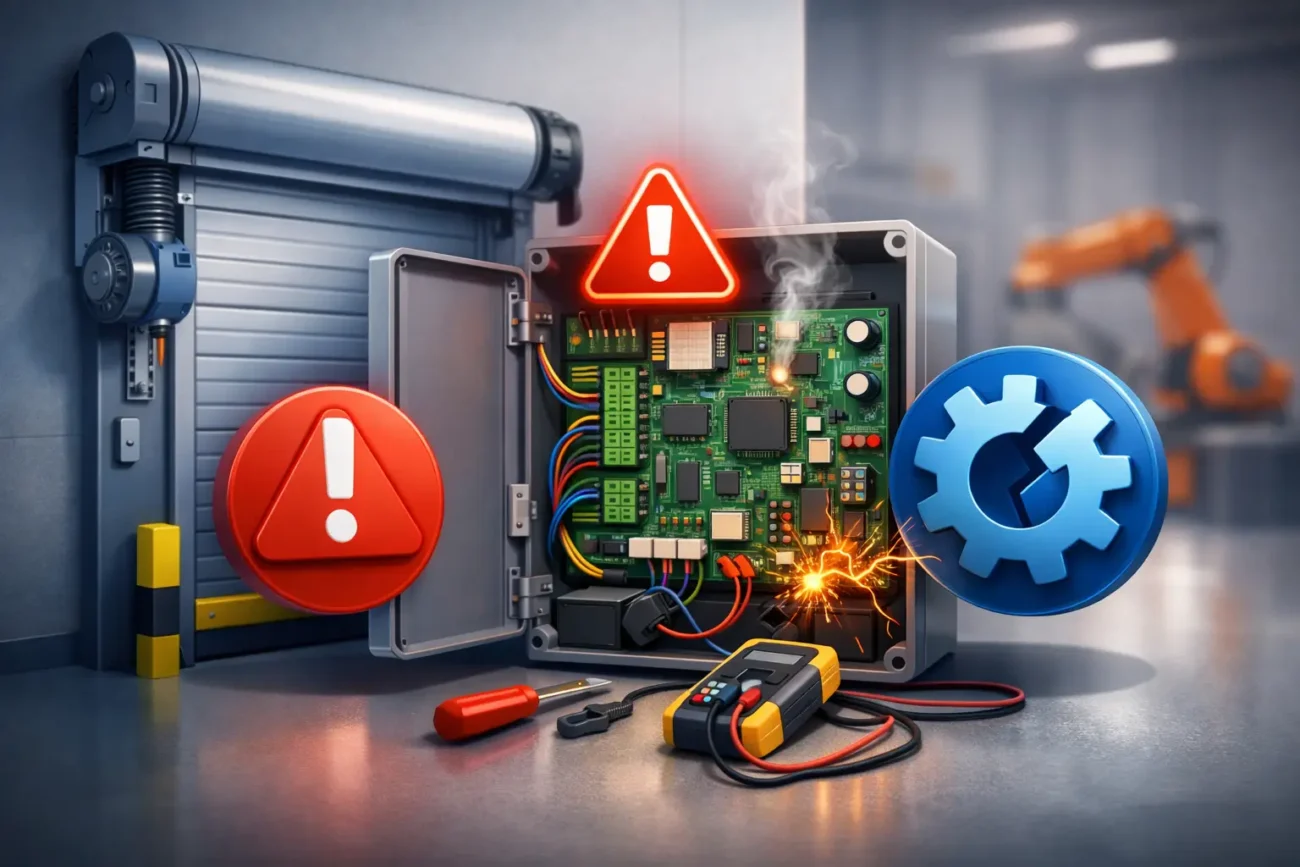
A shutter that will not close at 6am, a high-speed door stuck open on a chilled site, a sectional door tripping out between cycles – these are the moments when the industrial door control board stops being just another component and becomes the part holding up the whole operation. When that board fails, symptoms can look like a motor fault, a safety edge issue or a power problem. Getting the diagnosis right matters.
The control board is effectively the decision-making point of an automated industrial door. It receives signals from push buttons, remotes, photocells, limit switches, encoders and safety devices, then tells the motor and related components what to do. If the board is damaged, incorrectly configured or simply the wrong replacement, the whole system can become unreliable or unsafe.
What an industrial door control board actually does
On site, people often talk about the panel, the PCB or the controller as if they are all the same thing. Sometimes they are, sometimes they are not. In many door systems, the industrial door control board is the main electronic circuit inside a larger control panel enclosure. The enclosure may include contactors, transformers, relays, fuses and terminals, while the board handles logic, programming and signal processing.
That distinction matters when fault-finding. A burnt fuse or failed contactor can stop a door without the PCB itself being faulty. Equally, a board with damaged tracks, failed relays or corrupted settings can produce faults that look mechanical. If you replace the wrong part, you lose time twice – once on the incorrect diagnosis and again when the door still will not run.
In practical terms, the board controls opening and closing logic, dwell times, obstacle response, safety inputs, limit recognition and, on some doors, speed profiles and part-open settings. More advanced systems also manage diagnostic outputs, service counters and communication with external devices.
Common signs the industrial door control board may be at fault
The obvious sign is a completely dead door with power present elsewhere in the system. But many board faults are less clear-cut than that. A door may open but not close. It may close only on deadman operation. It may reverse without obstruction, ignore a command input, lose its limits or behave differently at different times of day.
Intermittent faults are especially common. Heat, moisture, vibration and age can all affect solder joints, relays and terminal connections. A board might work for ten cycles and fail on the eleventh. That usually points to a developing issue rather than a clean, total failure.
You might also see visible evidence. Burn marks, swollen components, corrosion, water ingress and damaged terminals all deserve attention. That said, a board can look fine and still be faulty. Electronic damage is not always visible, particularly after voltage spikes or gradual component degradation.
Error codes can help, but only if they are interpreted correctly. A safety input fault, for example, does not always mean the sensor is bad. It could be a failed input on the board, a wiring problem, a missing link, or a programming mismatch after a previous repair.
Faults that are often blamed on the board but are not
Not every non-responsive door needs a replacement PCB. Engineers and maintenance teams regularly find that the real cause sits elsewhere in the circuit. Failed photocells, broken spiral cable, faulty safety edges, worn limit switches, damaged encoders, transformer issues and poor incoming supply can all produce similar symptoms.
This is where a bit of patience saves money. If the board is changed before the surrounding components are checked, the replacement can be exposed to the same fault condition. A short on an accessory circuit or water ingress in field wiring can damage a new board as quickly as the old one.
Why industrial door control boards fail
Age is the simple answer, but not the only one. Many boards live in demanding environments where temperature swings, condensation, dust and vibration are routine. On busy industrial doors, cycle counts can be high enough to expose weak relays and tired terminals well before anyone expects it.
Power quality is another common factor. Voltage fluctuation, poor earthing and surges after electrical work can all affect sensitive electronics. Sites with older infrastructure sometimes see repeat control issues because the wider electrical environment is never fully addressed.
Moisture is particularly damaging. Even where the enclosure looks sealed, condensation can build up inside panels, especially on doors exposed to external temperature changes. Over time, corrosion affects terminals, tracks and connectors. Once that process starts, faults can become intermittent and awkward to trace.
Previous repairs can also create problems. Boards supplied with non-standard modifications, incorrect links, mismatched software or improvised wiring changes often become a source of repeat callouts. The door may run, but only until one setting or input exposes the mismatch.
Repair or replace – it depends on the board and the fault
There is no single rule here. Some industrial door control board faults can be repaired economically, particularly where the issue is limited to replaceable relays, terminals or obvious component damage. In other cases, repair is false economy. If the board is obsolete, badly corroded, previously repaired multiple times or tied to unstable operation, replacement is usually the safer route.
Availability plays a big part. For current manufacturers and supported models, a direct replacement board is often the fastest path back to service. For older systems, you may need to match part numbers carefully, identify revision levels, or source a compatible alternative where the original is no longer available.
The risk with substitutions is that close enough is often not close enough. Terminal layouts, motor outputs, voltage requirements, input logic and programming methods vary between brands and generations. A board that physically fits inside the panel may still be wrong for the application.
Information that helps identify the correct board
Part numbers are the best starting point, but they are not always easy to read after years inside a panel. A clear photo of the board, the control panel label and any stickers showing software or revision numbers can make a big difference. Motor details, door type and brand are also useful, especially when manufacturers have used multiple board variants across similar systems.
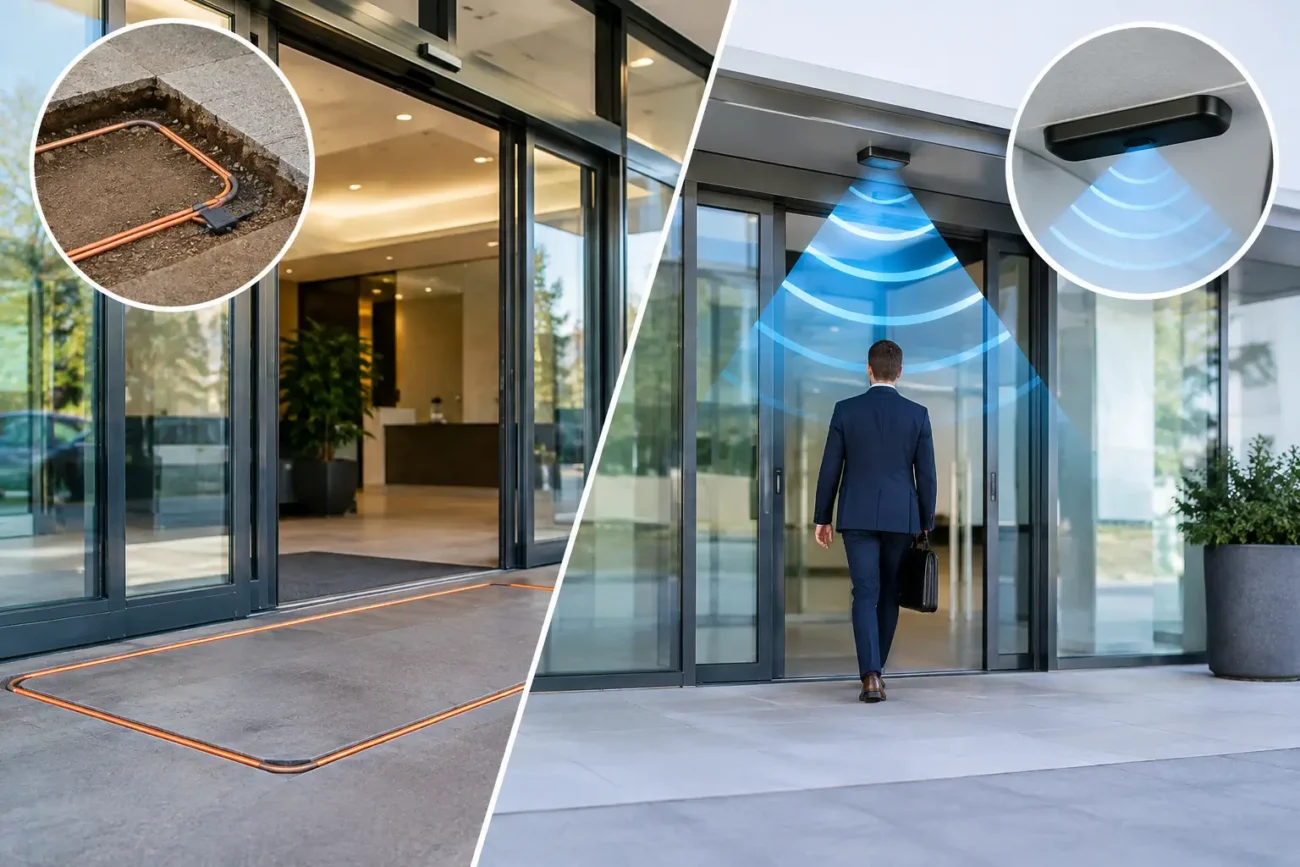
If the original part number is missing, the more site information you can provide, the better. Is it a roller shutter, sectional overhead door, high-speed door or folding door? Is the motor single-phase or three-phase? Are there external safety devices, radar activation, timer functions or frequency inverter controls involved? Those details narrow the field quickly.
For less technical buyers, this is exactly where proper support matters. Sending a few photos and a short description of the fault often gets to the answer faster than trying to guess from appearance alone.
What to check before ordering an industrial door control board
Before replacing the board, confirm the incoming supply, check fuses and inspect the panel for water ingress or heat damage. Verify whether the fault is on an input, an output or the board’s internal logic. If there is a display, note the error code before power is cycled.
It is also worth checking whether the board requires programming after installation. Some arrive ready for basic commissioning, while others need parameter setup, safety device configuration or limit learning before the door will operate correctly. Missing that step can make a good board look faulty.
Compatibility with the existing system is another major point. The board must match not just the door brand, but the motor arrangement, control method and safety setup already in place. On older sites, there may have been upgrades over the years, so the board currently fitted may not be the one the original door left the factory with.
The cost of getting it wrong
A control board is rarely the cheapest part in the panel, but the real cost is downtime. If a loading bay is blocked, goods movement slows. If a security shutter will not close, the site is exposed. If a fast-action door fails in a temperature-controlled area, energy loss and product risk soon follow.
That is why part accuracy matters more than headline price. The cheapest board is expensive if it is wrong, delayed or unsupported. Most trade customers would rather fit the right part once than spend another visit proving why the first choice did not work.
For facilities teams and end users, the same principle applies. A quick conversation backed up with photos, labels and symptoms usually saves more time than ordering on assumption. Where the part is hard to identify, specialist suppliers with experience across older and current industrial door systems can often trace details that generic sellers miss. That is often the difference between a one-day fix and an ongoing fault.
If you are staring at a panel and wondering whether the industrial door control board is actually the culprit, slow the process down just enough to get the evidence right. A clear part ID, a proper look at the surrounding components and a realistic view of repair versus replacement will usually get the door moving again faster – and with less waste. If the part is awkward to identify, that is the moment to ask for help rather than guess. It is exactly what good technical support is there for.


Leave a comment