


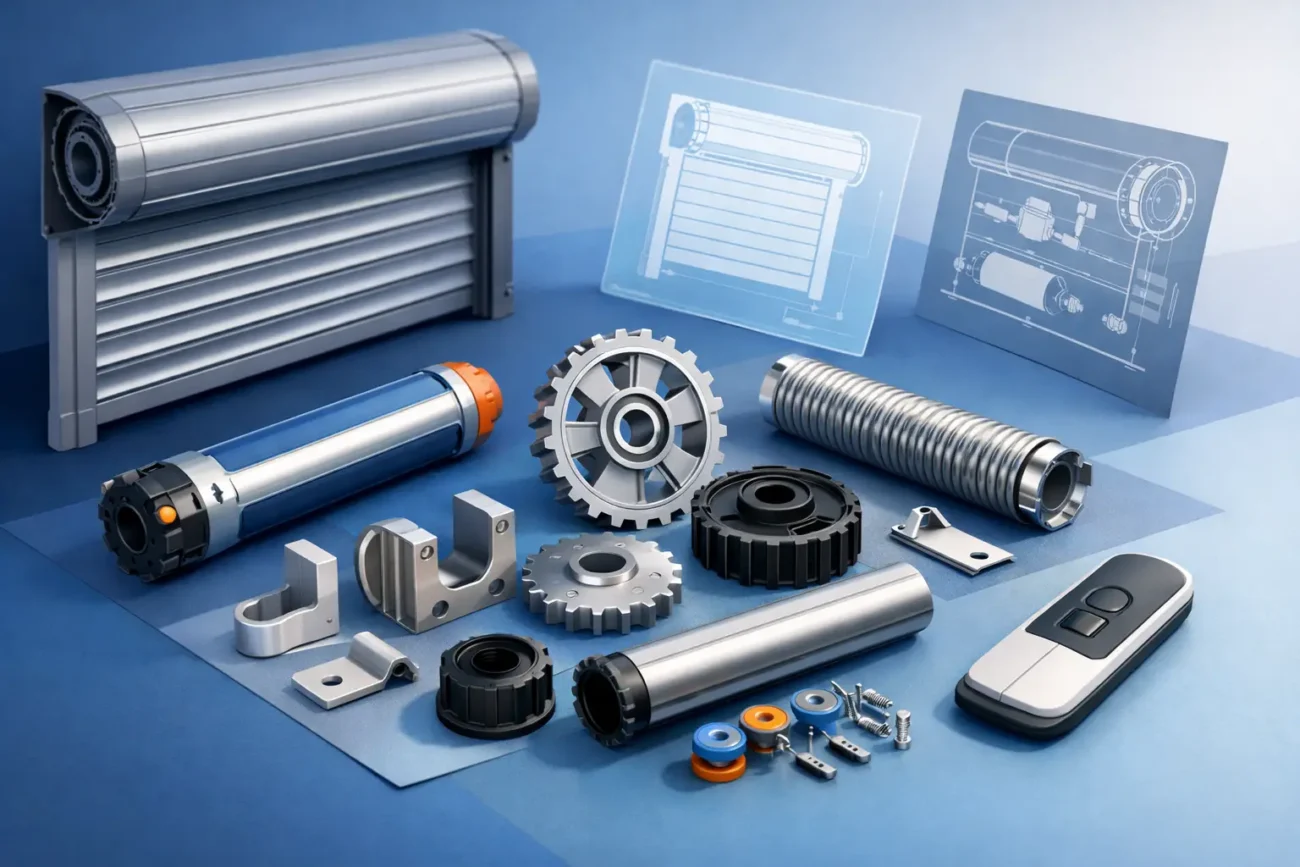
A shutter that will not open at the start of a delivery shift is not a minor inconvenience. It can stop vehicles entering, leave stock exposed, disrupt staff access and create a genuine safety issue. Getting the right roller shutter spare parts quickly starts with identifying what has failed, rather than ordering the part that looks most likely.
On a commercial or industrial site, shutters may appear similar from the outside while using very different motors, control panels, safety devices and curtain components. A correct replacement needs to match the door’s duty, dimensions, electrical arrangement and safety system. That is why a few checks before purchase can save a second call-out, unnecessary downtime and a part that cannot be fitted.
Start with the fault, not the part number
The symptom often narrows the search considerably. If the shutter has power but does not move, the problem may sit with the control panel, a stop button, a safety edge, photocells or a failed motor capacitor. If it runs but stops part way, limit switches, an encoder, damaged guides or curtain resistance may be involved. A noisy shutter that still operates could point to worn bearings, a loose chain, a damaged end plate or misalignment.
Do not assume that a non-moving shutter needs a new motor. Motors do fail, particularly on high-cycle doors, but replacing one without checking the controls and safety circuit can be an expensive misdiagnosis. Equally, repeatedly resetting a tripped safety device without finding the cause can leave a door unsafe to use.
Before investigating, isolate the electrical supply where appropriate and follow site procedures. Work on spring-loaded, electrically operated or high-level shutter systems should be carried out by a competent door engineer. The weight stored in the curtain and barrel assembly is not something to underestimate.
Identifying roller shutter spare parts accurately
The best part identification combines the manufacturer details with clear information about the installation. A photo of the failed component, the label on the motor or control panel, and an image showing how the part connects are often more useful than a general description such as “shutter sensor”.
For motors, record the make, model, voltage, power rating, shaft or mounting arrangement, and whether the unit has mechanical or electronic limits. For a control board, capture every number printed on the enclosure and board itself, along with photos of the terminal layout. Board revisions can matter, even where the outer casing looks identical.
Curtain and mechanical components need measurements as well as photographs. Slats, bottom rails, guides, end locks, axles and bearings are selected according to profile, thickness, width and fixing method. A replacement slat that is a few millimetres out may not travel cleanly through the guide, while the wrong end lock can cause curtain movement or snagging.
When checking a safety device, establish what type it is and what role it performs. A wired photocell pair, a wireless safety edge and a pressure-sensitive bottom edge are not interchangeable without considering the controller and existing safety circuit. The replacement must preserve the door’s intended safety function, not simply restore movement.
Common parts that cause avoidable downtime
Some components are more likely to need replacement because they are exposed to daily use, impact, weather or electrical wear. Keeping an eye on these areas helps teams respond before a complete failure occurs.
Motors, gearboxes and limit systems
A motor may become slow, overheat, hum without turning or trip its thermal protection. On tubular motors, worn limits or a failed capacitor can produce symptoms that resemble a complete motor failure. On industrial shaft-driven units, the gearbox, brake or limit assembly may be the actual issue.
Motor selection is not only about physical fit. The replacement must provide suitable torque for the curtain weight and door size, the correct operating voltage and compatible control method. A busy warehouse opening may need a different duty rating from a lightly used internal security shutter.
Control panels, receivers and transmitters
Control panels manage the motor, inputs and safety devices. Water ingress, power surges, loose terminals and ageing relays can all lead to erratic operation. If a panel has failed, check whether the replacement supports the existing motor, safety edge, photocells, key switch and remote controls.
Radio receivers and hand transmitters also need matching frequency and coding. Two remotes from the same manufacturer are not necessarily compatible. A clear photo of the original remote, receiver and any dip switches or code labels prevents guesswork.
Safety edges, photocells and sensors
Safety devices take frequent punishment on loading bays and busy entrances. A bottom safety edge can be damaged by pallet lorries, water and impact. Photocells may be knocked out of alignment, have dirty lenses or suffer cable damage where conduits enter the building.
Replacing a faulty sensor is only part of the job. Its position, alignment and function should be tested once fitted. If the shutter closes onto an obstruction, reverses unexpectedly or fails to respond to the safety system, keep it out of service until the fault is resolved.
Curtain, guides and hardware
Bent slats, damaged laths, worn end locks and deformed guides can make a shutter heavier to operate and place extra strain on the motor. Damage is often localised after a vehicle strike, but it can affect the whole curtain’s travel. Replacing only the visibly bent section can be sensible where the rest of the curtain is sound, although repeated damage or widespread corrosion may make a larger repair the better long-term choice.
Check compatibility before ordering
The quickest route to the right component is to provide the details that affect compatibility at the outset. For a trade engineer, that may mean supplying a manufacturer code and dimensions. For a facilities manager or property owner, good photographs and a description of the fault are often enough to begin narrowing the options.
Useful information includes:
- the manufacturer, model and any serial or part number;
- clear photos of labels, connectors, terminals and the installed component;
- door type, approximate opening size and whether it is internal or external;
- the fault symptoms, including lights, sounds, error codes or when the problem occurs;
- any previous repairs, alterations or impact damage.
Be cautious with “universal” replacements. Some are a practical solution where the original part is obsolete, especially for controls and radio equipment. However, a universal product may require rewiring, programming or changes to safety devices. It can be the right answer, but only if the installation is assessed as a complete system.
Repair now or plan for replacement?
A single failed component does not automatically mean the entire shutter is at the end of its life. Replacing a capacitor, limit switch, photocell or damaged slat can return a sound door to service at modest cost. This is usually the sensible route where the curtain runs smoothly, the guides are secure and the system has been maintained.
The calculation changes when faults repeat. A tired motor working against a distorted curtain will continue to struggle. A control panel repeatedly affected by water ingress needs the source of ingress addressed, not just a new board. Where parts are becoming obsolete, a planned upgrade can be less disruptive than waiting for a failure that closes an entrance without warning.
For sites with essential access points, it is worth keeping selected spares on hand. The right stock depends on the equipment and risk, but commonly used items include remotes, safety edges, photocells, fuses, key switches and suitable control components. There is little value in holding random parts, so base the selection on the actual doors on site and their history of faults.
Get support when the part is unclear
Older shutters often carry faded labels, and previous repairs may have introduced non-original parts. In those cases, a specialist sourcing service is more useful than guessing from a catalogue image. Door Spares UK Ltd can help identify hard-to-find components through its Ask Dora service, using photos, measurements and fault details to locate a suitable match or compatible alternative.
The goal is not simply to get the door moving again. It is to restore reliable operation without compromising safety, security or the next day’s work. Keep a record of each shutter’s make, controls and previous repairs while it is still running properly – when a fault occurs, that small bit of preparation can make finding the right part much faster.




Leave a comment