


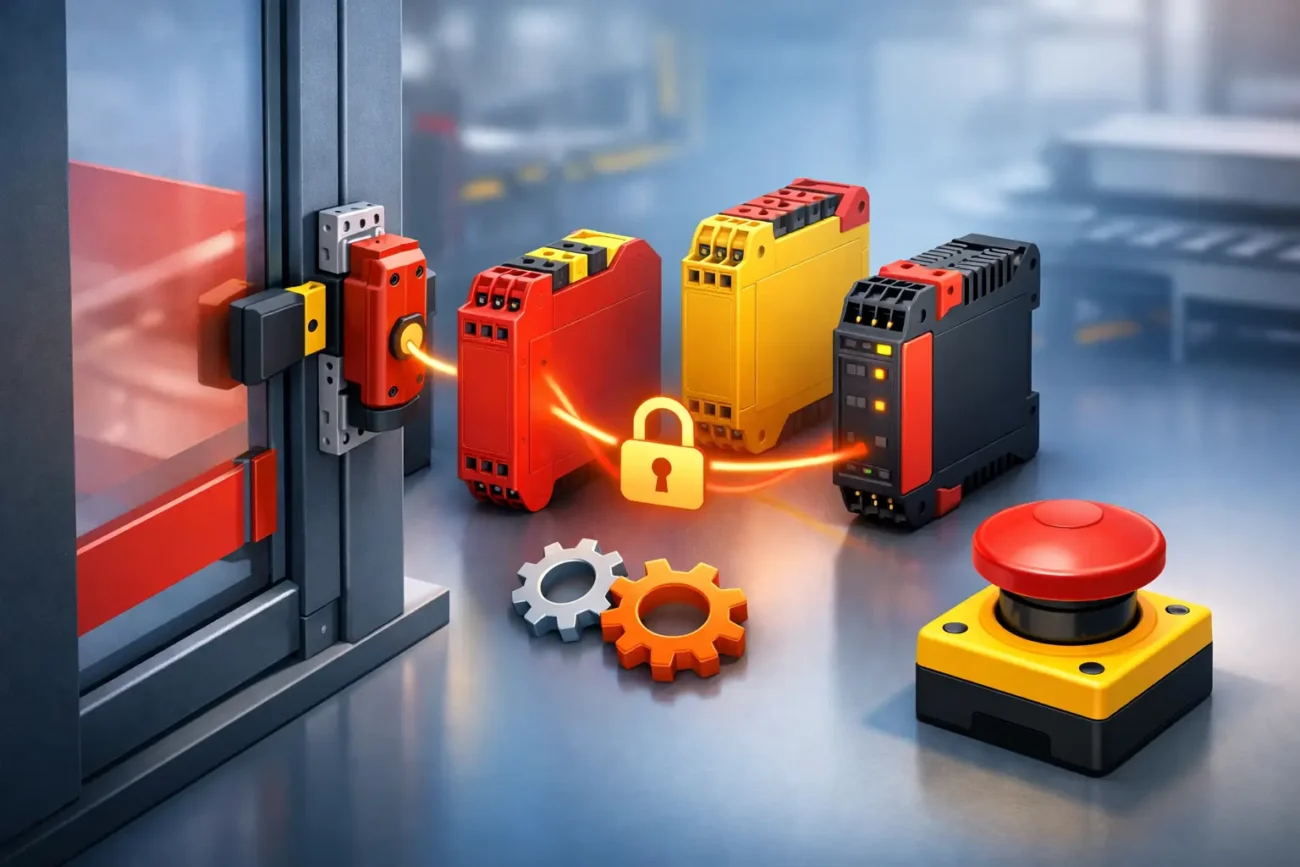
A door that will not reset after a guard opens is frustrating. A door that resets when it should not is dangerous. That is why choosing the best door safety relays is not really about buying a popular part – it is about making sure the relay matches the door, the safety circuit and the job the system has to do.
In practice, there is no single relay that suits every roller shutter, rapid door, sectional door or automated pedestrian entrance. Engineers and facilities teams usually need the same thing: a relay that is compatible, easy to fault-find and dependable under daily use. The right choice protects people first, but it also cuts nuisance stoppages and wasted call-outs.
What makes the best door safety relays?
The best door safety relays are the ones that fit the safety architecture of the door system without forcing compromises. That sounds obvious, but plenty of problems start when a relay is chosen on voltage or terminal count alone.
A proper door safety relay monitors safety inputs such as emergency stops, safety edges, photocells, interlocks or guard switches, then checks that outputs switch correctly before allowing motion. On many industrial and commercial doors, it also needs to work cleanly with the existing control panel logic, reset method and fault monitoring.
What matters most depends on the application. A high-speed door on a busy warehouse opening has different demands from an automatic swing door in a public building. One may need faster response and resistance to repeated cycles. The other may place more emphasis on predictable reset behaviour and compatibility with pedestrian safety devices.
Start with the door, not the relay
The quickest way to buy the wrong part is to begin with catalogue photos. Start with the actual door system instead. Check the make and model of the door controller, the supply voltage, the type of safety devices connected, and whether the relay is handling a single-channel or dual-channel circuit.
You also need to know what the relay is expected to monitor. Some systems are simple, with an emergency stop and one interlock. Others combine safety edges, light curtains, guard switches and monitored reset inputs. If you fit a relay that cannot properly supervise the circuit, you may end up with persistent faults or, worse, an unsafe bypassed setup on site.
This is where experienced sourcing matters. Older or mixed-brand installations are common across the UK, especially where sites have added upgrades over time. A relay that looks close enough on paper may still be wrong if the monitoring logic or contact arrangement is different.
Key features to look for in door safety relays
There are a few practical features that usually separate a suitable relay from a headache.
First is input compatibility. The relay must suit the devices already in the circuit, whether that is a safety edge system, magnetic switch, emergency stop chain or interlocked guard. Dual-channel monitoring is often preferred where the application calls for higher fault detection.
Second is the output configuration. You need the right number and type of safety contacts, plus any auxiliary contacts required for signalling back to the control panel. Too few contacts creates workarounds. The wrong contact arrangement can stop the system functioning altogether.
Third is reset logic. Manual reset, monitored reset and automatic reset all have their place, but they are not interchangeable. On a door system where someone may still be in the hazard zone, the wrong reset method creates unnecessary risk.
Finally, think about diagnostics. Clear LED indication sounds basic, but on a cold service visit it can save a lot of time. If an engineer can quickly see whether the fault is input loss, feedback loop failure or supply issue, the repair is faster and the downtime shorter.
Best door safety relays for common applications
Rather than naming a single winner, it makes more sense to look at what works best by use case.
For industrial roller shutters and sectional doors
In these systems, reliability and straightforward integration usually matter most. The best choice is often a safety relay with proven compatibility with common industrial control panels, stable dual-channel monitoring and simple feedback loop checking. These doors are often repaired under time pressure, so relays with clear status indication and familiar wiring layouts tend to be the better option.
If the site has older controls, be careful with newer relay designs that introduce different reset requirements or monitoring behaviour. They may be technically better, but still not the best fit for the installation without wider panel changes.
For high-speed and rapid doors
Rapid doors cycle hard and often. In that setting, consistent response and dependable monitoring are more important than extra features you will never use. A relay that copes well with frequent operation and works cleanly with photocells, safety edges and motion control circuits is usually the safer bet.
Here, false trips can become an operational problem. If a relay is overly sensitive to wiring noise or poorly matched to the sensors on the door, the site will feel it quickly. Warehouses and production areas do not thank anyone for a door that stops every hour.
For automatic pedestrian doors
Pedestrian systems often involve a different balance. Safety remains critical, but integration with door operators, activation sensors and presence detection can be more specific to the manufacturer. The best relay in this context is one that matches the operator logic and approved safety setup rather than the one with the broadest spec sheet.
This is especially true where compliance and public access are involved. If you are replacing a failed relay in a pedestrian entrance, exact fit and correct function matter more than trying a near equivalent.
Common mistakes when choosing a safety relay
One of the most common mistakes is treating the relay as a generic electrical component. Safety relays are application-specific parts. Terminal count, coil voltage and physical size are only part of the story.
Another mistake is overlooking feedback monitoring. If the relay expects external device monitoring and the panel is not wired for it, the system may never reset properly. Conversely, removing or bypassing feedback because it is inconvenient creates a serious safety problem.
There is also the issue of environment. Control panels on industrial doors can face vibration, temperature swings, dust and moisture. Even when a relay is housed inside the panel, site conditions still matter. A part that works perfectly in a clean plant room may not prove as dependable on a busy loading bay door.
Then there is substitution. If the original part is obsolete, a replacement may exist, but only after checking wiring logic, safety category, outputs and reset behaviour. This is not the place for guesswork.
Repair, replace or upgrade?
Sometimes a failed relay is just a failed relay. Other times it is the first visible symptom of a wider issue in the circuit. Replacing the part without checking field devices, contactors and wiring can lead to repeat failures.
If the relay is obsolete, the sensible option may be an upgrade rather than a direct replacement. That can improve diagnostics and long-term availability, but it may also mean panel modifications. For a critical door, the best answer is often the one that gets the system back into safe, maintainable service with the least disruption – not necessarily the cheapest part on day one.
For maintenance teams, stockholding can be worth thinking about too. If a site has multiple doors using the same relay type, keeping a known-compatible spare can reduce downtime dramatically.
When technical support matters most
Door safety relays sit right in the space where electrical control, mechanical operation and safety compliance meet. That is why part identification can get awkward fast, especially on older installations or where the original label is missing.
If you have the manufacturer, model, panel details or even a clear photo of the existing relay and wiring, sourcing becomes far easier. This is where a specialist supplier earns their keep. Door Spares UK Ltd deals with the kind of real-world parts questions that do not show up neatly in a basic search, particularly when a site needs the right answer quickly rather than three possible maybes.
A practical way to choose the right relay
If you are trying to narrow down the best option, begin with five checks: door type, controller model, supply voltage, safety devices in circuit, and reset method. Then confirm contact configuration and whether external device monitoring is required. That basic picture rules out a lot of bad matches straight away.
After that, think about serviceability. Can your engineer test it easily? Are fault indications clear? Is it a current part with dependable availability? Those questions matter just as much as technical compliance when the door is critical to site operations.
The best door safety relay is rarely the one with the most features. It is the one that fits the system properly, behaves predictably under fault conditions and can be supported when the pressure is on. If there is any uncertainty, stop short of a guess and get the part checked properly – it is always cheaper than chasing a wrong relay across repeated breakdowns.




Leave a comment