


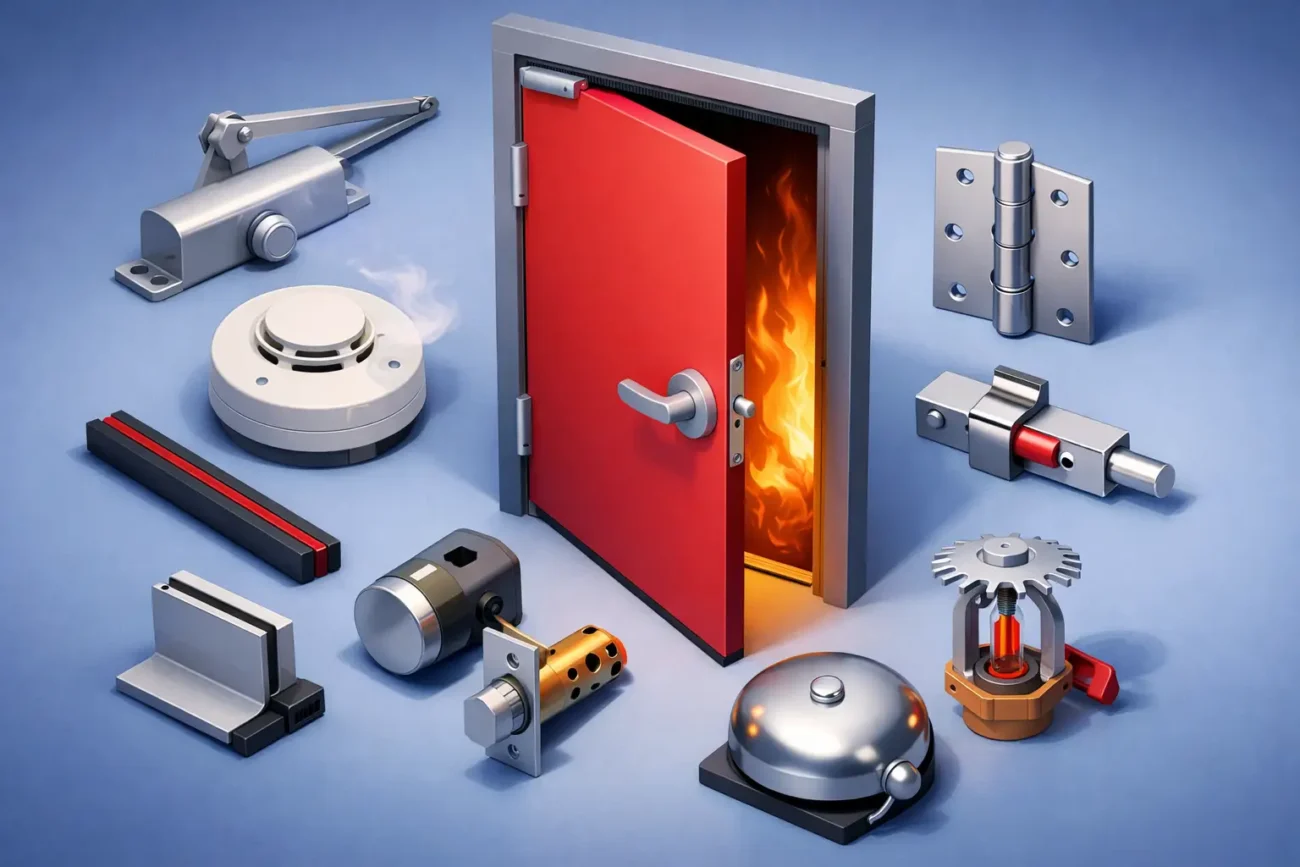
A fire door can look fine at a glance and still fail where it counts. That is usually the problem on site. The leaf is in place, the frame seems sound, but one missing seal, the wrong closer, or a worn hinge can compromise the whole set. If you are trying to identify the best fire door components, the right question is not which parts look strongest. It is which parts are proven, compatible, and correctly specified for the door set you actually have.
That matters whether you are maintaining a commercial block, fitting out an industrial unit, or replacing a failed part in a live building where downtime is not an option. Fire doors work as a system. Treating individual components as if they are universal is where many expensive mistakes start.
What makes the best fire door components?
The best fire door components are the ones that match the tested specification of the door set, meet the required fire rating, and keep performing under daily use. That sounds obvious, but in practice buyers are often dealing with incomplete site records, older doors, multiple manufacturers, and urgent replacement needs.
A good component is not just compliant on paper. It also needs to suit the real operating conditions. A closer on a lightly used office corridor door may not suit a busy warehouse personnel entrance. A latch that works well with one lock case may create issues with another. Even small changes in ironmongery can affect closing force, smoke control, and alignment over time.
That is why the best choice is often the most accurate one, not the cheapest or the most readily available. Fire performance depends on the whole assembly working together.
Best fire door components to prioritise
Hinges
Hinges do more than carry the weight of the door. They help maintain alignment, support reliable closing, and withstand heat during a fire event. On many fire doors, hinges need to be CE marked or UKCA marked where applicable, fire rated, and fitted with the correct fixings.
The trade-off here is durability versus suitability. Heavy duty hinges may sound like the obvious answer, but they still need to be right for the door leaf, frame material, and frequency of use. Poor hinge selection often shows up as dropped doors, binding, uneven gaps, or latch failure.
Intumescent seals and smoke seals
These are easy to overlook because they are not the most visible part of the door set, but they are critical. Intumescent seals expand under heat to help close the gap between door and frame. Smoke seals help restrict the spread of cold smoke, which is often the bigger life safety risk in the early stages of a fire.
The key detail is size and compatibility. Fitting the wrong seal profile, or cutting and patching mismatched sections, can affect performance. If a seal is damaged, painted over, missing, or poorly fitted, it is not doing its job.
Door closers
A fire door that does not close properly is a problem, full stop. Closers are one of the most important components in day-to-day performance because they make the door return to the closed position after use.
The best option depends on traffic levels, door width, accessibility requirements, and the environment. Overhead closers are common, but not all deliver the same control. Some sites need adjustable closing speed and latching action. Others may need hold-open devices linked to the fire alarm system, and those must be specified very carefully. A wedge under the door is not a workaround. It is a failure point.
Latches, locks and keepers
The latch keeps the door positively shut within the frame. Without that, even a well-fitted closer cannot guarantee the door will perform as intended. Fire-rated latches and locks need to suit the door set and be installed with the correct intumescent protection where required.
This is one of the areas where mixed parts can cause trouble. A replacement sashlock or tubular latch might physically fit the cut-out, but if it is not suitable for that fire door configuration, you are creating a compliance issue as well as a safety risk.
Handles and hardware furniture
Handles, push pads, pull handles, escutcheons and related hardware are often replaced for wear or appearance, but on a fire door they are not just decorative items. They have to withstand regular use without affecting the performance of the latch or lock case.
The best hardware is usually the simplest fit for the application. High traffic commercial settings need hard-wearing finishes and reliable return-to-door performance. In lower traffic areas, appearance may carry more weight, but it should never override fire rating and compatibility.
Glazing systems and vision panel components
If a fire door includes glazing, the glass, glazing beads, liners and seals all matter. Fire-resistant glass is only part of the equation. The surrounding system must also be correct and tested.
This is not an area for guesswork. Replacing a damaged bead with a standard timber section, or swapping glass without checking the full specification, can invalidate the fire performance of the door. If there is any uncertainty, it is worth stopping and confirming the tested detail rather than making assumptions on site.
Drop seals and threshold seals
Where smoke control and acoustic performance matter, drop seals and threshold sealing can play an important role. These components are often specified in corridors, flats, hotels and mixed-use buildings where both fire and smoke resistance are under scrutiny.
The practical issue is wear. Threshold areas take a lot of punishment, and poor adjustment can lead to drag, damage, or incomplete sealing. The best product here is one that balances sealing performance with smooth operation over time.
Why compatibility matters more than brand alone
Buyers often ask for a trusted make, and that makes sense. Known manufacturers usually offer better consistency, traceability, and technical data. But the brand name by itself is not enough.
A well-made closer from a respected manufacturer is still the wrong component if it does not suit the door mass, width, or use pattern. The same goes for seals, hinges and lock cases. With fire doors, compatibility beats assumption every time.
This is especially relevant on older properties and refurbished sites. The original specification may have changed over the years, parts may have been swapped piecemeal, and documentation may be incomplete. In those cases, accurate identification becomes half the job. A photo, dimensions, markings, and a clear description of the door can save a lot of back and forth and reduce the chance of ordering the wrong item.
Common mistakes when choosing fire door parts
The most common mistake is treating a fire door like a standard door with upgraded hardware. It is not. A fire door is a tested assembly, and each component affects how that assembly behaves.
Another frequent issue is replacing only the obviously failed part without checking the surrounding wear. A worn closer may be linked to dropped hinges or a damaged latch. A missing smoke seal may sit alongside poor frame gaps. Swapping one part may help temporarily, but it will not always solve the underlying problem.
There is also the temptation to choose on price alone, especially when several doors need attention at once. Cost matters, of course. But a cheaper part that fails early, does not fit correctly, or raises compliance concerns rarely saves money in the long run. On busy sites, repeat callouts cost far more than getting the part right first time.
How to choose the right component for your site
Start with the door set, not the catalogue. Identify the fire rating, the manufacturer if known, the dimensions, and the current hardware. Check for labels, markings, certification clues, and signs of previous modification.
Then think about the real conditions. Is the door used occasionally or constantly? Does it need smoke control as well as fire resistance? Is accessibility a major factor? Is the environment dry, exposed, dusty, or subject to heavy impact? These details affect what counts as the best fire door components for that specific opening.
If the exact part is unclear, technical support matters. That is where a specialist supplier earns its keep. Door Spares UK Ltd works with trade professionals and end users who often need help identifying exact-fit parts quickly, particularly when site information is incomplete or the part is no longer obvious from appearance alone. In practical terms, that can mean the difference between one delivery and three failed attempts.
When replacement is not enough
Sometimes the right answer is not another spare. If the door leaf is badly damaged, the frame is out of tolerance, or the opening has been altered, replacing components alone may not restore compliant performance.
That is not always what buyers want to hear, but it is better than forcing parts onto a door that should be repaired properly or replaced entirely. The best fire door components can only perform if the base door set is still fit for purpose.
A sensible approach is to treat every replacement as part of a larger check. Look at the gaps, the closing action, the latch engagement, the seals, the frame condition and any glazing details together. That gives you a clearer picture of whether you are maintaining a good door set or patching a failing one.
Getting fire door parts right is rarely about finding the fanciest product on the shelf. It is about matching proven components to the door in front of you, so the building stays safer and the job does not come back on your snagging list next month.





Leave a comment