


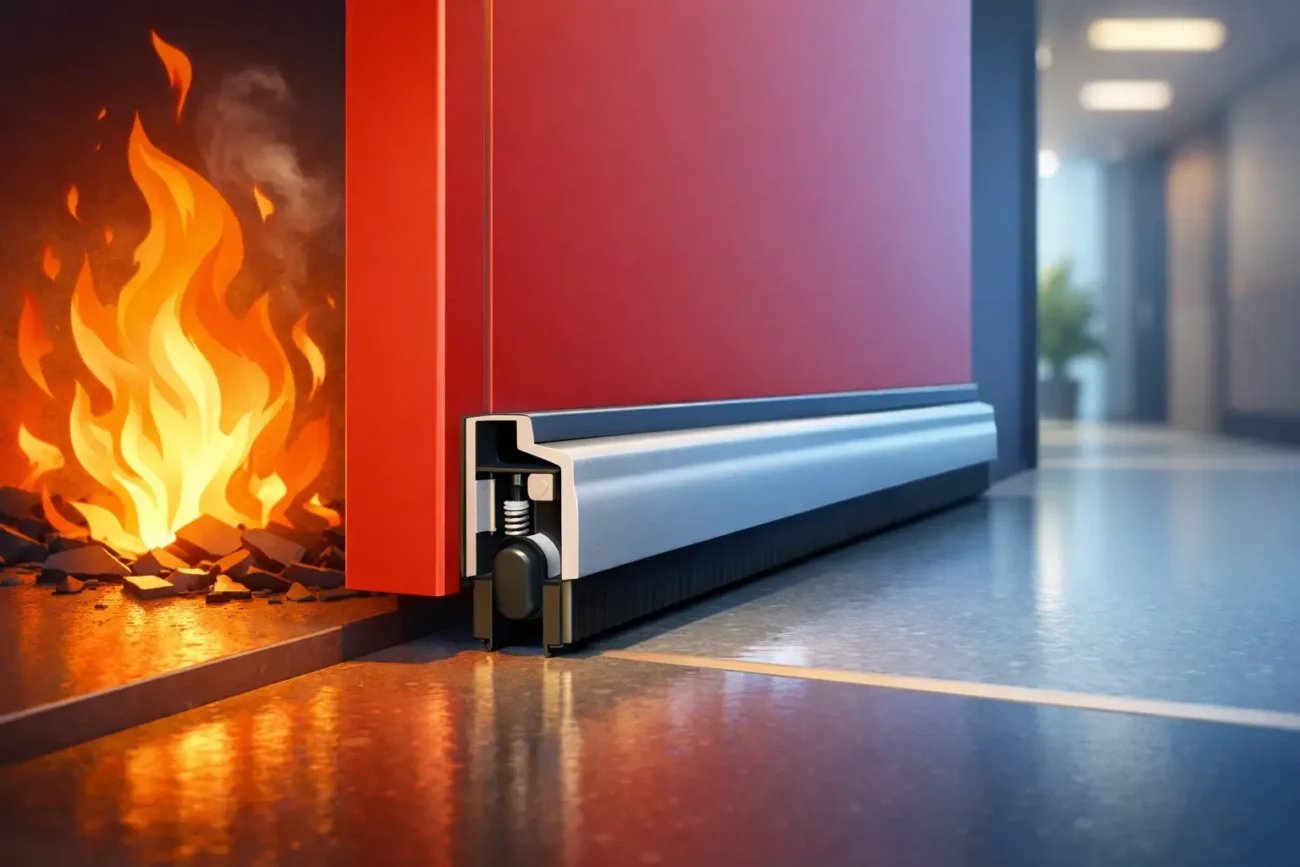
A fire door drop seal is one of those components people often notice only when it stops doing its job. The door may still close, the frame may still look sound, but if smoke can pass under the leaf or the seal fails to drop cleanly, the door set is no longer performing as intended. In a commercial building, that is not a small issue. It affects compartmentation, day-to-day comfort, and the basic reliability of the opening.
For facilities teams, installers and maintenance engineers, the challenge is usually not understanding that the seal matters. It is identifying the right type, checking whether it is still serviceable, and making sure the replacement suits the door, floor finish and fire rating. That is where small specification details make a big difference.
What a fire door drop seal actually does
A fire door drop seal is a mechanical seal fitted into the bottom edge of a door leaf, or sometimes surface mounted, which drops down when the door closes and lifts clear when the door opens. The idea is simple. You get a tight seal at threshold level without the drag and wear you would get from a fixed strip constantly scraping the floor.
On many installations, the drop seal is there to help restrict the passage of smoke. Depending on the door set and specification, it may also improve acoustic performance and reduce draughts. In practical terms, that means better separation between spaces, less nuisance from air movement, and more predictable performance from the door in everyday use.
That said, not every seal does every job. Some are selected mainly for acoustic control, some for smoke containment, and some are used as part of a wider fire door assembly where the full door set has been tested to meet a specific rating. This is where assumptions can cause problems. A drop seal that fits physically is not automatically the right seal for the application.
Why the bottom gap matters more than many people think
When people inspect a fire door, they often focus on the obvious items – hinges, closers, glazing, intumescent strips and latch alignment. The gap under the door can get less attention, especially if the leaf appears to shut properly. But the threshold area is one of the easiest paths for smoke leakage and air transfer.
If the gap is too large, or the seal does not make even contact across the floor, performance drops quickly. You may also see secondary issues. A poorly adjusted seal can slap the floor too early and stop the door from latching. If it drops too late, it leaves a visible gap on the closing side. If the floor is uneven, one end may seal while the other stays open.
In busy buildings, these faults are common because doors take knocks, floors settle, thresholds get changed, and replacement leaves are sometimes fitted without checking the original sealing arrangement. A working seal is not just a fit-and-forget item.
Fire door drop seal types and where they are used
Most fire door drop seal products fall into two broad categories: mortised and surface mounted. A mortised seal is recessed into the bottom edge of the door, which gives a neater finish and protects the body of the seal from impact. Surface-mounted versions are usually quicker to fit and can be useful where machining the door leaf is not practical.
Activation is normally by a small button at one end of the seal. When the door closes against the frame, that button is pressed, causing the sealing bar to drop. Better-quality units allow some adjustment so the seal drops at the right point and applies the right amount of pressure.
Floor condition matters here. A smooth, level threshold gives the most reliable result. On rough or uneven floors, some seals cope better than others, but there are limits. If the floor finish has dips, ridges or transitions, the best answer may be a different threshold detail rather than simply changing the seal.
Choosing the right fire door drop seal
The right choice depends on the door set, not just the gap under the door. Start with the basics: door thickness, leaf construction, required fire rating, smoke control needs, floor finish, and whether the seal is replacing an existing tested component.
Compatibility is the point many buyers underestimate. Fire doors work as assemblies. If you are replacing a failed drop seal on a certified door set, the safest approach is to match the existing specification as closely as possible unless the manufacturer confirms an alternative. Swapping in a similar-looking part without checking can create issues with compliance, fit or closing performance.
You also need to look at operating conditions. In schools, hospitals, warehouses and blocks of flats, doors may be used hundreds of times a day. That means wear resistance and consistent operation matter as much as headline performance. In plant rooms or service risers, sealing performance may take priority over aesthetics. In offices or meeting spaces, acoustic control may be a bigger factor.
This is why a quick photo and a few measurements are often more useful than guessing from memory. If the old seal is damaged, a clear image of the profile, fixing method and any markings can speed up identification considerably.
Signs a drop seal needs replacement
Some failed seals are obvious. The rubber may be torn, the mechanism may stick, or the body may be loose in the door bottom. Others are less visible until someone checks the closing action closely.
A fire door drop seal is worth investigating if the door scrapes at the threshold, fails to latch cleanly, leaves daylight underneath when closed, or no longer lifts fully on opening. Excessive noise transfer between rooms can also point to a worn or badly adjusted seal. In older buildings, repainting and floor changes sometimes mask the real issue for months.
Another warning sign is repeated adjustment elsewhere on the door. If people keep altering the closer, latch or hinges to compensate for poor closing, the real fault may be at floor level. It is rarely efficient to keep tuning hardware around a failed seal.
Installation and maintenance considerations
Fitting a drop seal is not difficult in principle, but getting it right takes care. The seal needs to suit the door bottom preparation, sit square, and be adjusted so it contacts the floor evenly without obstructing the closing cycle. Too much pressure can strain the door closer or cause the latch to bounce. Too little leaves the threshold unsealed.
For maintenance teams, periodic inspection makes sense, especially on high-traffic doors. Check that the actuator button moves freely, the seal drops evenly, the fixing points are secure, and the door still closes and latches under normal use. Also check whether floor coverings have been changed. A new carpet tile, threshold strip or vinyl build-up can alter the gap enough to affect the seal.
Where there is any doubt about certification or compatibility, get technical advice before ordering. That is usually faster than ordering a part twice and finding the first one does not suit the door.
Why sourcing the correct part can save time on site
On paper, a drop seal can look like a standard component. On site, the differences soon show up. Length, travel, profile, activation style and fire performance all vary. That is why part identification matters, particularly when the door is on a live commercial site where downtime needs to be kept short.
For trade buyers and facilities teams, the fastest route is usually to work from the existing part where possible. Measurements, photos, door details and any markings on the seal body help narrow things down. If the original is obsolete or unclear, a specialist supplier can often identify a suitable replacement or confirm whether a like-for-like option is available. That is far more dependable than trying to match it by eye from a generic catalogue.
This is the kind of practical problem Door Spares UK deals with every day. Not every customer has a part number to hand. Sometimes they have a worn seal, a site photo and a deadline. Getting from that point to the right component quickly is what matters.
When it depends
There is no single answer to whether a fire door drop seal is essential on every fire door. Some door sets rely on different threshold arrangements, and the specification always comes back to the tested assembly and building requirements. Equally, replacing a seal is not always the whole fix. If the door is twisted, the frame is out, or the threshold has been altered, a new seal on its own may not solve the problem.
That is why the best approach is practical rather than theoretical. Look at the full opening, not just one failed part. Check how the door closes, how the gaps measure up, what the floor is doing, and whether the replacement will maintain the intended performance of the door set.
A small component at the bottom of the leaf can make a very real difference. Get it right, and the door works as it should with less fuss, less wear and fewer call-backs.


Leave a comment