


A loading-bay door that stops halfway open is not a minor maintenance job. It can hold up deliveries, leave stock exposed and create a safety risk for staff and visitors. This commercial door spares guide is designed to help engineers, facilities teams and property owners identify the likely fault, specify the right replacement and avoid losing more time by ordering a part that will not fit.
The first rule is simple: do not order from appearance alone. Many door components look nearly identical, but a different voltage, shaft size, handing or control-board version can turn an urgent repair into a second call-out. A clear identification process gets the door moving again faster and helps keep the repair safe.
Commercial door spares guide: start with the fault
Before removing anything, establish what the door is doing and what it is not doing. A door that has no power, a door that runs but will not close, and a door that reverses during travel may all involve different components. The visible part is not always the failed part.
Start with the basics. Check that the local isolator is on, emergency stops are released and the supply has not tripped. Look for fault codes or indicator lights on the control panel, then inspect cables, terminals and plugs for damage, moisture or loose connections. On automated doors, a dirty photocell, misaligned safety sensor or damaged safety edge can prevent movement even when the motor and control board are healthy.
If a door has become noisy, travels unevenly or jams at the same point, inspect the mechanical side as well. Worn rollers, damaged tracks, broken cables, springs, hinges or bearings can overload the operator. Replacing the motor without addressing the resistance in the door may only lead to another failure.
Always isolate electrical equipment before working on it, and do not bypass safety devices to get a door operating. A temporary workaround can create a much larger problem, particularly on a busy warehouse, fire escape route or public entrance.
Record these details before ordering
A good parts enquiry is based on evidence, not guesswork. Take clear photographs before disconnecting the old component, including the label, terminals, wiring positions and its location on the door. For most commercial door spares, the useful information is:
- the manufacturer, door type and model where known
- the full part number and any revision, serial or date code
- electrical details such as voltage, phase, wattage and supply type
- key measurements, including shaft diameter, length, fixing centres and cable length
- a description of the fault and any control-panel error message
For a motor, include photos of the gearbox, encoder and mounting arrangement. For a control board, photograph the complete board, its label and every connector. For a sensor or safety device, show the bracket, cable entry and the device face. These details can distinguish between parts that share a housing but perform different functions.
The spares that most often stop a door
Commercial door systems have a mixture of consumable mechanical parts and electronic components that can fail with age, impact, weather or heavy use. Knowing the usual weak points helps narrow the search.
Safety devices and sensors
Photocells, light curtains, induction loops and pressure-sensitive safety edges are often the reason a door will not close. Forklift impact, poor alignment, water ingress and damaged cables are common causes. Some systems use monitored safety circuits, so a replacement must have the correct resistance, switching arrangement and compatibility with the controller. A sensor that physically fits may still fail the safety test if it is the wrong type.
Pedestrian automatic doors have their own set of safety components, including presence sensors, activation sensors, control switches and programme selectors. The make and model matter here because detection patterns, connector types and control protocols vary considerably.
Motors, gearboxes and encoders
Slow operation, repeated thermal cut-outs, unusual noise or a door that loses position can point to the motor assembly, gearbox or encoder. However, check the door balance and mechanical travel first. A sectional or roller shutter door with excessive resistance can make a replacement motor work beyond its intended load.
Match motor spares carefully. Confirm the supply voltage, whether it is single-phase or three-phase, output speed, torque, duty cycle, brake specification and encoder type. On older operators, the original motor may have been superseded, which can mean a compatible replacement needs a new adapter, limit system or control-board setting.
Control boards, receivers and remotes
Control panels are the decision-makers in an automated system. They take signals from safety devices, limits, switches and transmitters, then command the motor. A burned component, water damage or intermittent relay can cause erratic behaviour, but wiring faults and failed peripherals can produce the same symptoms.
When replacing a board, identify the exact version and confirm what is connected to it. You may need to transfer settings, programme travel limits, set motor direction or pair remotes again after installation. Radio receivers and hand transmitters should be matched by frequency and coding system, not just by button layout.
Mechanical, fire and security parts
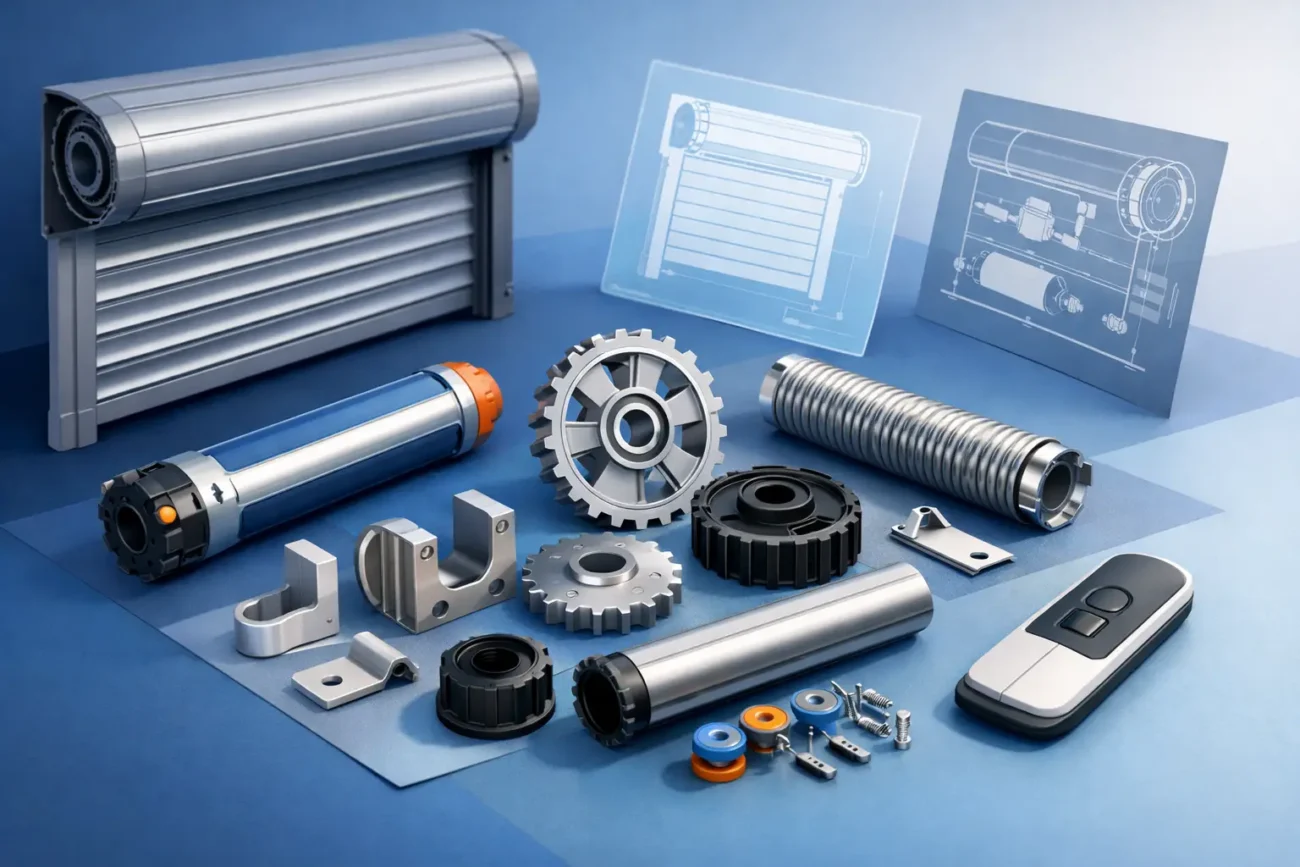
Rollers, hinges, cables, drums, sprockets, bearings and bottom seals may not look as urgent as an electronic fault, but they are central to safe, reliable movement. Replacing worn rollers before they damage a track is generally cheaper than waiting for a door to jam during a shift.
Fire-rated and security doors deserve particular care. Closers, panic hardware, intumescent components, hinges and locking hardware must be suitable for the door assembly and its required performance. Do not substitute a general-purpose item where a rated component is required. The door may close and latch, yet no longer meet its fire or security specification.
How to make sure the replacement is correct
The manufacturer part number is the strongest starting point, but it is not the only check. Suppliers and manufacturers occasionally change a component without changing the broad product description. A revised board might use different terminals; a replacement safety edge may require a different end cap; a motor may need a new fixing plate.
Compare the old and proposed part against the practical details: dimensions, connectors, cable position, handedness, operating environment and function in the system. Left- and right-hand components are a regular source of ordering errors, particularly with hinges, gearboxes, latching hardware and some operators. Stand facing the reference side specified by the manufacturer before deciding the handing.
For outdoor gates, barriers and loading doors, consider the environment as well as fit. An enclosure rating suitable for a dry plant room may be unsuitable at an exposed entrance. If the original failure followed flooding, condensation or repeated impact, solve that underlying issue when fitting the spare. Otherwise, the new part may not last.
Compatibility is especially important where parts have been superseded. A newer equivalent can be the right choice, but only when its required accessories, settings and installation changes are understood. This is where a photo of the existing unit and a full description of the application can save a costly mistake.
Repair or replace? Make the call on condition, not urgency alone
A replacement part is usually the sensible answer when the rest of the system is in good condition, the fault is clearly identified and the component remains supported. It keeps cost and downtime under control, particularly for a sensor, roller, remote, safety edge or contactor.
A broader repair may be wiser when multiple components are worn, the operator is obsolete, safety circuits have been repeatedly bypassed in the past, or the door has suffered structural damage. Repeated board failures, for example, may indicate a failing motor, poor supply quality or water ingress rather than bad luck with electronics.
Think about the cost of downtime as well as the purchase price. A warehouse door that stops deliveries, a barrier that blocks access or an automatic entrance that cannot be used by customers may justify replacing related worn items during the same visit. That does not mean changing parts at random. It means inspecting the system properly while access equipment and labour are already on site.
Keep the right critical spares, not a cupboard full of guesses
Sites with several doors benefit from a small, controlled spares holding. The best stock depends on the doors, their duty cycle and the consequence of failure. A distribution site may prioritise photocells, safety-edge components, rollers and remote controls. A public building may need pedestrian door sensors, batteries, push pads or programme switches. A site with older operators may decide that one known-compatible control board is worth keeping available.
Keep a simple asset record for each door: manufacturer, model, serial number, installation date, controller type, motor details, service history and common spares. Update it after every repair. This turns the next breakdown from a search through old paperwork into a targeted order.
Avoid buying multiple speculative parts “just in case”. Electronic components can have revisions, and storage conditions matter. Instead, identify the parts that are genuinely common across your site and agree a practical response plan for unusual items.
When a photo and a conversation are the quickest route
Not every failed part has a readable label, particularly on older industrial doors. If you have measurements, photographs and a clear description of the fault, specialist sourcing support can often identify the component or a suitable replacement. Door Spares UK Ltd’s Ask Dora service is built for exactly this situation: send what you can see, explain what the door is doing and get help narrowing down the correct spare.
The useful question is not simply, “What part do I need?” It is, “What has failed, what must the replacement work with, and what will prevent the same fault returning?” Get those answers right, and the repair is more likely to last beyond the next busy shift.


Leave a comment