


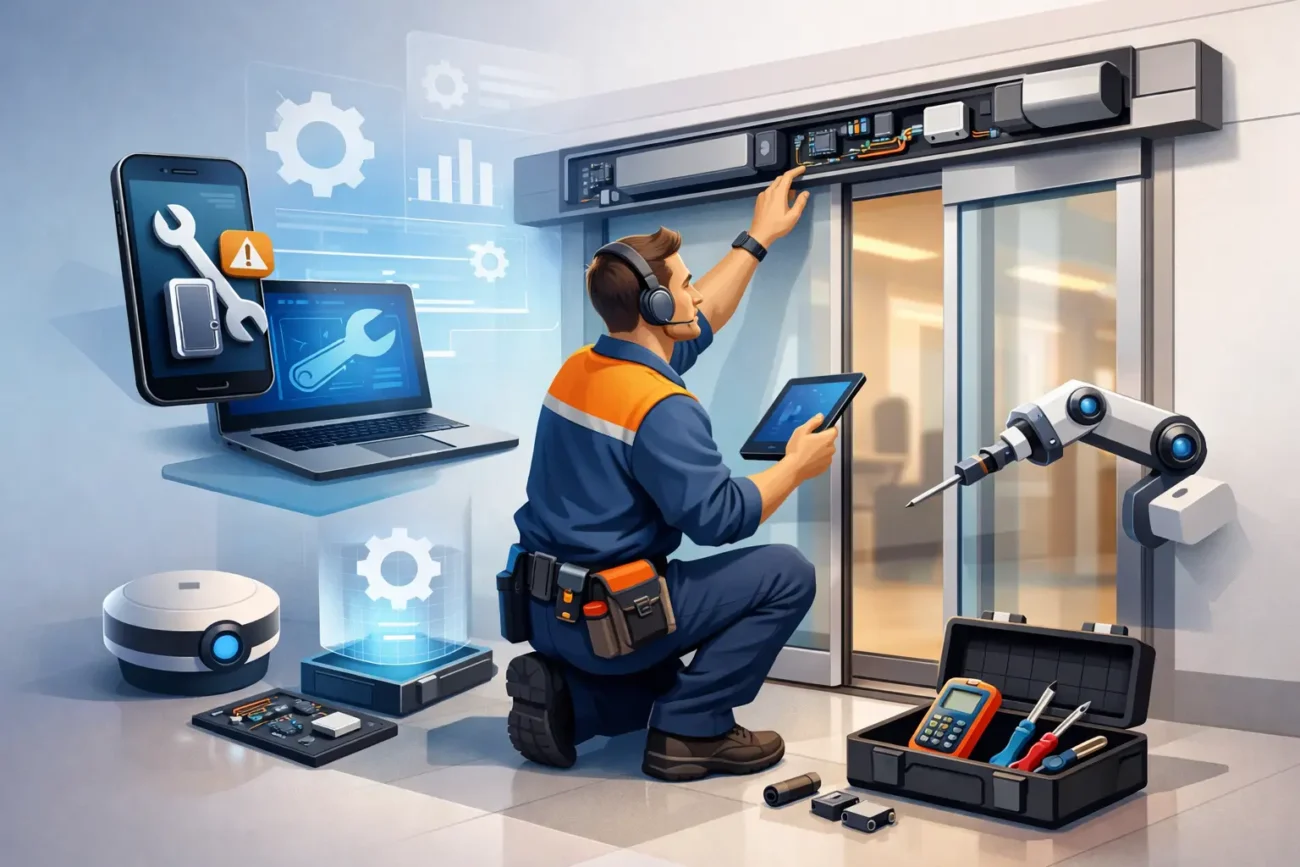
When an automatic door stops mid-cycle, reverses for no clear reason, or refuses to respond at all, the problem is rarely just the door. It can be a safety edge, encoder, motor, control board, photocell, power issue, setup error, or a part that has been fitted before without solving the real fault. Good door automation technical support saves time because it gets past guesswork and focuses on what the system is actually telling you.
For engineers, facilities teams, and site managers, that matters for one simple reason – downtime spreads. A failed shutter can hold up loading, a faulty pedestrian operator can create access issues, and an unreliable gate or barrier can quickly become a security problem. The cost is not only the replacement part. It is the call-out, the lost time, the interrupted traffic flow, and sometimes the risk of using a system that is no longer operating safely.
What door automation technical support should actually cover
Technical support in this sector needs to do more than answer basic product questions. It should help identify faults, narrow down likely causes, confirm part compatibility, and reduce the chance of ordering the wrong item. That applies whether you are dealing with an industrial sectional door, a high-speed door, a garage operator, a gate automation setup, or an automatic pedestrian entrance.
The strongest support usually starts with the symptoms rather than the catalogue. A door that opens but will not close points you in a different direction from a door that is completely dead. A barrier that runs intermittently may suggest a sensor issue, moisture ingress, or a board fault rather than a motor failure. If the support process jumps straight to “you need a new unit”, there is a fair chance money is being spent too early.
In practice, useful support often means asking the right questions. What make and model is fitted? Has any work already been carried out? Are there flashing LEDs or error codes on the controller? Has the fault appeared suddenly, or has it become worse over time? Has anything changed on site, such as impact damage, water exposure, or recent electrical work? Those details matter because automated door systems fail in patterns.
Why accurate fault finding beats quick assumptions
A common problem with automated doors is that several faults can look similar from the outside. A non-responsive door might be suffering from a failed transformer, blown fuse, faulty board, broken cable, or failed motor capacitor. A door that stops short could be a limit setting issue, resistance in travel, a sensor alignment problem, or encoder feedback failure.
This is where experience counts. A support team that deals with control panels, motors, sensors, safety devices and brand-specific parts every day is more likely to separate the likely from the unlikely. That does not mean every diagnosis can be done remotely. Some faults need on-site testing with a meter, inspection of mechanical wear, or confirmation of live inputs and outputs. But remote technical support should still shorten the path.
There is also a safety point here. Automatic doors, gates and barriers are not like swapping a domestic appliance part and seeing what happens. Incorrect components, bypassed safety devices, or poor setup can create pinch risks, impact risks, and non-compliance issues. Technical support should help you restore safe operation, not just movement.
Door automation technical support for parts identification
One of the biggest delays in this trade is not the repair itself. It is identifying the exact part. Labels are worn off, machines are older than the paperwork, and previous repairs may have introduced alternative boards or motors. On many sites, the person ordering the part is not the person standing in front of the door.
That is why part-finding support is as valuable as fault diagnosis. A clear photo of the motor plate, control panel, sensor, or handset can often narrow the search far quicker than a general description. Dimensions, connector types, terminal layout, and housing shape can all help confirm what is fitted, especially on older industrial doors where documentation is patchy.
There is a trade-off, though. Visual matching alone is not always enough. Two boards can look similar but have different firmware or parameter ranges. Two transmitters may share a casing while using different frequencies or coding methods. Two safety photocells may mount the same way but have different operating voltages. Reliable support checks the detail before a part is sent out.
For that reason, the best approach is usually to provide as much information as possible at the start: make, model, serial number if available, photos of the whole assembly and close-ups of labels, plus a brief fault description. It sounds basic, but it can save a day or two of back-and-forth and avoid a return that could have been prevented.
Where technical support adds the most value
Not every enquiry needs the same level of input. Some customers know the exact component they need. Others know only that the door has stopped and operations need it working again. Strong support works for both.
For engineers and installers, the value is often speed and confirmation. If you are already on site and suspect a failed encoder, board relay, or photocell, you need to know whether the replacement is correct and available. For facilities teams and property owners, the value is translation. The support process turns a vague fault into a practical next step, whether that is ordering a part, carrying out a check, or arranging further investigation.
It is also especially useful on discontinued or harder-to-find systems. Many sites still rely on older automation that cannot simply be replaced overnight. In those cases, sourcing support becomes part of technical support. Finding a suitable replacement part, cross-referencing an obsolete code, or identifying a compatible component can keep a system in service without forcing a full upgrade before it is needed.
Common faults and why they are rarely one-size-fits-all
Sensors and safety devices are a regular source of trouble, but not always because the component itself has failed. Misalignment, dirt, damaged wiring, moisture and power supply issues can all produce similar symptoms. Replacing the sensor may solve it, or it may leave the original fault untouched.
Control boards are another area where support matters. A burnt track or failed relay is one thing. A board that appears faulty because of an external short, incorrect accessory connection, or unstable incoming supply is another. Fitting a new board without checking the wider circuit can become an expensive repeat job.
Motors, capacitors and gear assemblies also need a bit of caution. Slow running, stalling, or rough movement might point to the motor, but it can also come from worn springs, poor balance, seized bearings, drag in the curtain or track, or incorrect limit setup. Electrical and mechanical faults often overlap in automated doors, which is why a proper diagnosis has to consider both.
Choosing support that helps rather than slows you down
Good support is clear, direct, and realistic about what can be confirmed remotely. It should not overpromise, and it should not bury you in jargon for the sake of sounding technical. The real test is whether it helps you move from fault to fix with fewer delays.
That usually means fast responses, sensible questions, and a willingness to work from photos when site information is limited. It also means recognising urgency. If a warehouse door is down or an access system is out of service, nobody wants a lecture. They want practical help and the right part sent quickly.
This is where a specialist supplier has an advantage over a general seller. Broad product coverage matters, but hands-on experience matters more. If the support team understands common failures across brands such as BFT, FAAC, NICE, Tormax, Hörmann, Dorma and industrial door control systems, the conversation becomes shorter and more useful. If they can also help source awkward or older parts, better still.
At Door Spares UK Ltd, that practical approach is exactly why services like Ask Dora resonate with busy customers. When the label is faded, the part number is missing, or the fault is not obvious, people do not need a scripted reply. They need someone who can look at the evidence, ask the right questions, and help point them to the correct component.
Getting better results from technical support
If you want faster, more accurate help, treat the support request like a site handover. Include the door type, brand, controller details, fault behaviour, any error indications, and what has already been replaced or tested. Add clear photos and note whether the system is dead, intermittent, reversing, failing to close, or stopping in travel. That level of detail gives technical support something solid to work with.
It also helps to be clear about the outcome you need. Sometimes the priority is the fastest possible repair. Sometimes it is confirming a part for a planned maintenance job. Sometimes it is deciding whether a repair is still sensible on an ageing system. Support is more useful when those priorities are stated upfront.
The best technical support does not just answer the question that was asked. It helps uncover the one behind it. If your automatic door is failing, you do not just need a component. You need confidence that the part is right, the fault is understood, and the system can go back into service safely. That is what makes proper support worth having when the pressure is on.



Leave a comment