


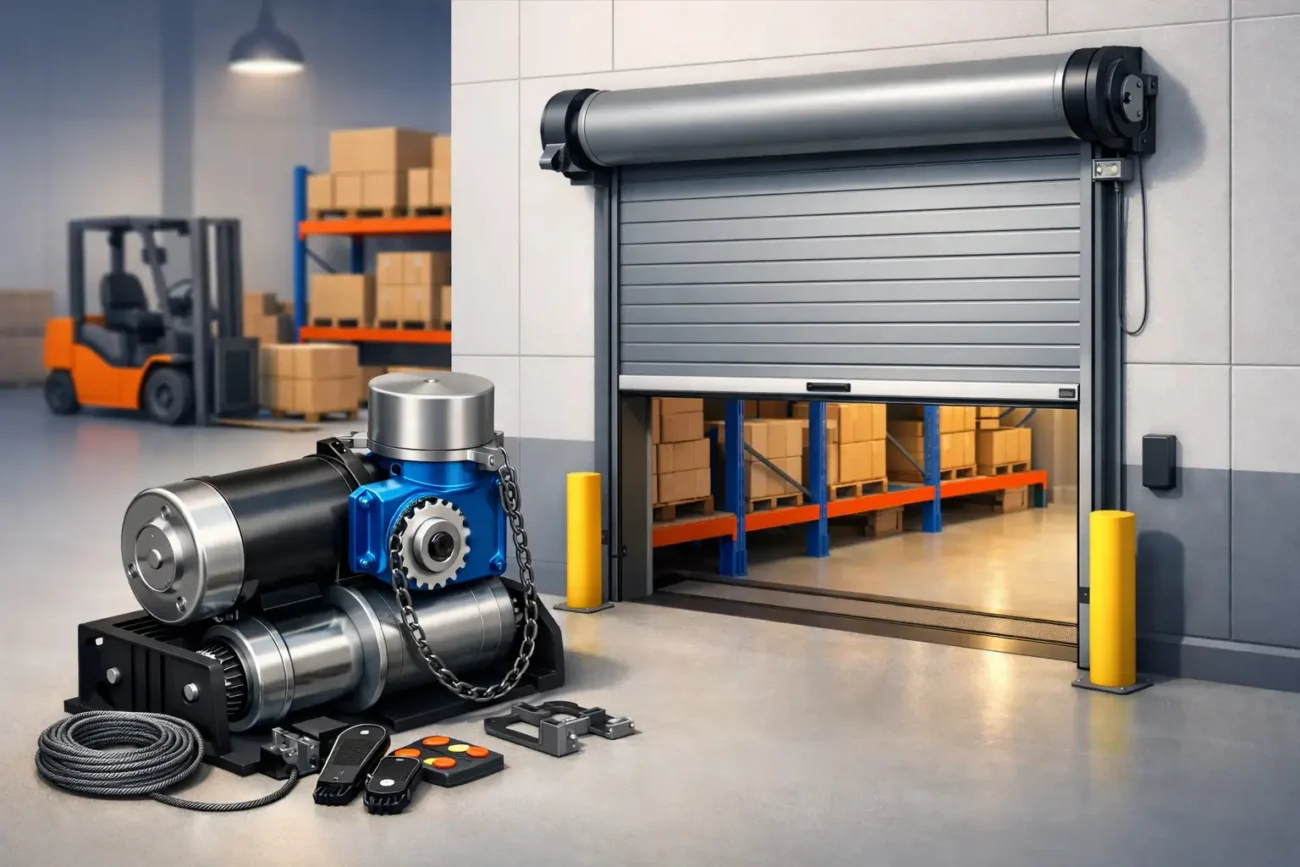
A warehouse door that starts hesitating, reversing for no clear reason, or refusing to lift under load rarely fails at a convenient time. When you need a replacement door motor for warehouse operations, the real problem is not just finding a motor quickly. It is making sure the new unit actually matches the door, the control setup and the site demands, so you are not back on the same callout a week later.
In industrial settings, door motors fail for all sorts of reasons. Some reach the end of their service life after years of heavy cycles. Others are damaged by voltage issues, water ingress, worn brake assemblies, failed limit systems or ongoing strain caused by poor balancing elsewhere in the door. That is why replacing like for like is not always as simple as reading the label and ordering the first match you see.
Choosing a replacement door motor for warehouse doors
The correct motor depends on more than brand and voltage. Warehouse doors vary widely in weight, opening speed, duty cycle and operating environment. A sectional overhead door on a distribution unit has very different demands from a rapid roll door in a chilled goods area or a steel roller shutter on a loading bay.
The first question is whether the motor itself is truly the failed component. A door may appear to have a motor issue when the underlying fault sits with the control panel, safety edge, photocells, encoder, gearbox or mechanical resistance in the curtain or track. If the old motor is overheating because the door is binding, fitting a new one without resolving the root cause simply shifts the failure point.
Where the motor is confirmed as faulty, matching starts with the basics. Check the make, model, power rating, torque, mounting style, shaft size, brake type and limit arrangement. Also look at whether the unit is single-phase or three-phase, whether it uses an integral control system or separate panel, and whether it is intended for intermittent or intensive use.
That last point matters more than many buyers expect. A warehouse with constant forklift traffic may put hundreds of cycles through a door every day. A lower-duty motor may fit physically but still be the wrong part for the job.
What to check before ordering
A clear motor nameplate is useful, but it is not always enough. Over time, doors are modified, controls are changed and previous repairs may have introduced non-original parts. The safest approach is to confirm both the motor details and the door application.
Start with the obvious identifiers. Brand, product code and electrical data often narrow the search quickly. After that, look at how the motor connects to the door. Output shaft dimensions, hand of operation, chain override, emergency release and fixing points all affect compatibility.
It also helps to note how the limits are set. Some warehouse door motors use mechanical limit switches, while others rely on digital or encoder-based positioning. Swap one type for another without checking control compatibility and installation becomes far more complicated than it needs to be.
Photos usually save time. A clear image of the motor, nameplate, mounting point and control board can often reveal details that a typed description misses. For buyers who are not certain what they are looking at, this is often the quickest route to the right part.
Signs the motor is not the only issue
A failed motor can be the headline problem, but not the whole story. If the door has been running noisily, dropping unevenly, tripping safety circuits or struggling in cold weather, there may be mechanical or electrical faults elsewhere in the system.
Watch for worn bearings, damaged cables, weak springs, brake wear, moisture inside enclosures and signs of overheating in the panel. A replacement motor fitted to a poorly balanced door will work harder than it should from day one. That shortens service life and increases the risk of another stoppage.
Like-for-like or equivalent replacement?
In an ideal world, you would fit the exact original part. In practice, some motors are obsolete, discontinued or difficult to source at short notice. That does not always mean the repair stops there. A suitable equivalent may be available, but only if the key operating characteristics line up.
This is where technical support matters. An equivalent motor might match voltage and power yet still differ in speed, limits, brake specification or mounting configuration. Sometimes an adapter, revised settings or a control change makes the substitution workable. Sometimes it turns a simple replacement into an avoidable headache.
Common mistakes when buying a warehouse door motor
The most common mistake is ordering purely by appearance. Many industrial door motors look similar, especially across older installations, but small differences in shaft size, torque output or limit setup can make a part unusable on site.
Another frequent issue is assuming the motor and controller are independent. On some systems they are closely linked. If the old setup uses specific feedback, integrated safety monitoring or programmed travel settings, the new motor must work with that arrangement.
There is also the temptation to upgrade power without checking the rest of the system. More power is not automatically better. An oversized motor can create control, safety and wear issues if the door mechanics and panel were designed around a different operating profile.
Then there is urgency. When a warehouse opening is out of action, speed matters. But rushed ordering based on partial information often creates longer delays, not shorter ones. One accurate order is always faster than returning the wrong unit after the engineer has already attended site.
Why warehouse environments are hard on door motors
A replacement door motor for warehouse settings needs to cope with conditions that are tougher than many people realise. Dust, temperature swings, high cycle volumes, accidental knocks, washdown regimes and inconsistent power supply all shorten component life.
Loading bays are especially demanding. Doors may operate in short bursts all day, often in poor weather and with pressure to keep traffic moving. In food, pharmaceutical or chilled storage sites, environmental conditions can introduce extra strain through condensation, low temperatures or strict cleaning requirements.
That is why application matters just as much as part number. A motor that performs well in a lightly used commercial doorway may not last in a busy warehouse where uptime is critical and stoppages have a direct operational cost.
When fast supply matters most
If a warehouse door is stuck shut, deliveries stall. If it is stuck open, security, temperature control and site safety can all become immediate concerns. In both cases, downtime quickly costs more than the component itself.
Fast supply is important, but only when backed by proper identification. A specialist supplier can usually help narrow down the right replacement from photos, codes and door details, and that support often matters most when the original manufacturer information is unclear. For older or hard-to-find parts, that sourcing help is often the difference between a same-week repair and a much longer delay.
For buyers across the UK dealing with urgent industrial door faults, that practical support is often worth more than a long catalogue page. Door Spares UK Ltd works with engineers, facilities teams and end users who need exact-fit parts and straight answers quickly, especially where warehouse downtime is already affecting operations.
Should you replace the motor only or the full operator?
It depends on the age and condition of the system. If the motor has failed but the gearbox, brake, limits and controls are sound, a motor-only replacement may be the most cost-effective route. If the operator is heavily worn, obsolete or showing multiple faults, replacing the full assembly can save repeat labour and future disruption.
There is no single rule here. On a relatively modern setup with clear part identification, replacing one component often makes good sense. On an older warehouse door with patch-repaired electrics and intermittent faults, a broader replacement may be the better commercial decision.
The right answer usually comes down to lifecycle cost rather than purchase price alone. One cheaper part that keeps an ageing system limping along is not always cheaper once repeated callouts, delayed goods movement and engineer time are added up.
Getting the right information first time
If you are trying to source a replacement quickly, gather as much detail as you can before you order. A few good photos, any visible labels, door type, approximate size, site voltage and a short description of the fault will usually speed things up considerably.
If the motor has no readable label, include images of the control board, hand chain, mounting position and the door itself. Even experienced engineers come across motors that have been repainted, relabelled or swapped years earlier. Good identification is often detective work, not guesswork.
A warehouse door motor is not just another spare. It is a working part of a safety-critical, traffic-critical system. Get the match right and you restore reliable operation. Get it wrong and the door stays down, the site stays disrupted and the repair bill tends to grow.
If you are unsure, ask before ordering. A few minutes spent confirming the part is usually the quickest way to get the door moving again.


Leave a comment