


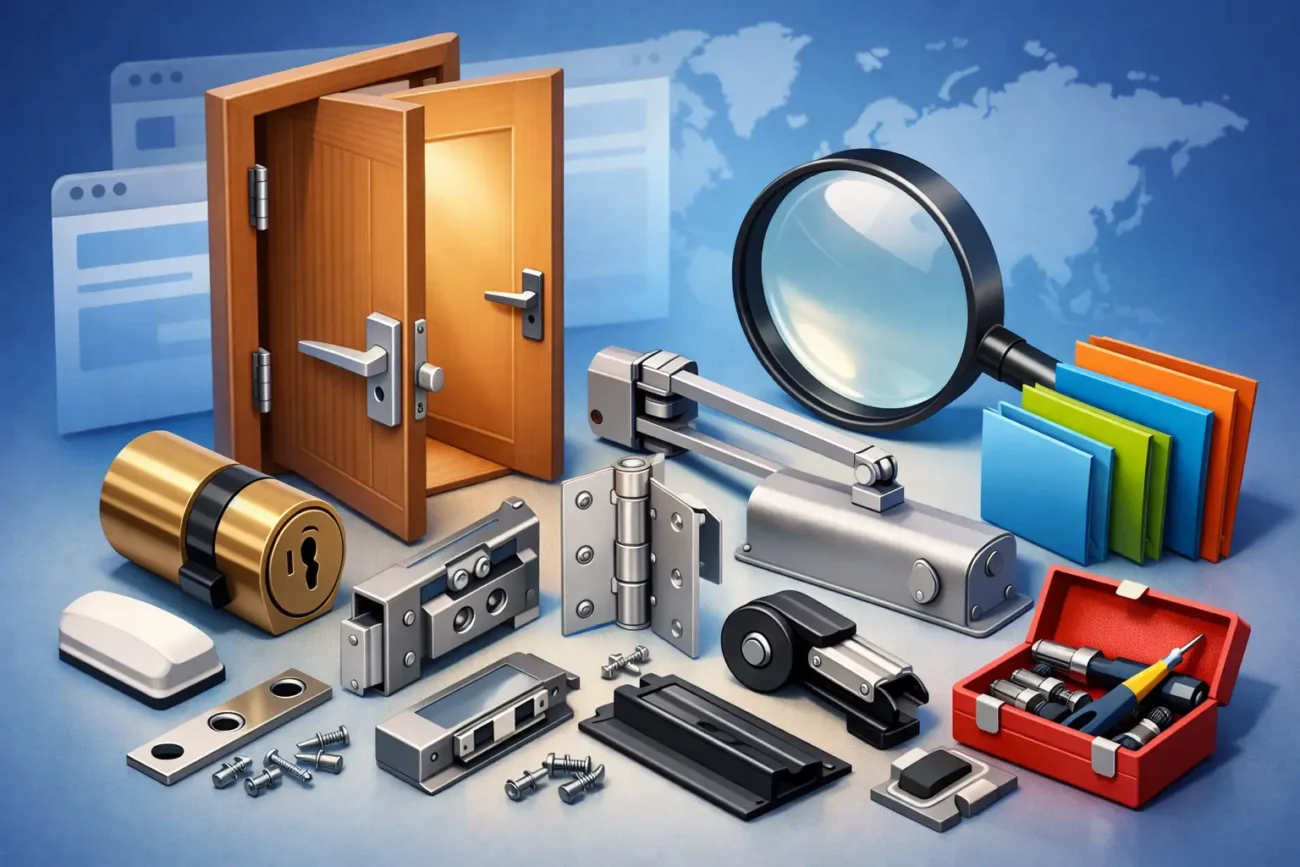
When a shutter stops mid-cycle, an automatic entrance starts faulting, or a barrier arm refuses to reset, the problem is rarely dramatic – it is usually one small component that nobody can identify on sight. That is why hard to find door parts cause such expensive delays. The real issue is not just availability. It is knowing exactly what you are looking at before you order the wrong thing.
For engineers and facilities teams, that usually means pressure from two sides at once. The site wants the door back online, but the part number is worn off, the original installer has disappeared, and the manufacturer details are vague at best. For property owners and less technical buyers, it can be even harder. You know something has failed, but not whether you need a sensor, encoder, control board, limit switch or motor assembly.
Why hard to find door parts become difficult to source
Most parts do not become difficult because they are rare in absolute terms. They become difficult because door systems change over time, model ranges overlap, and manufacturers revise components without making field identification easy. A control board may have had three versions. A motor may look identical across two operators but use different ratios or connectors. A safety sensor may fit the housing but not the control logic.
Older industrial and commercial doors add another layer. Labels fade, housings are repainted, and previous repairs may have introduced non-original parts. By the time a replacement is needed, the door on site may no longer match the paperwork in the file. That is common on sectional doors, high-speed doors, roller shutters, automated pedestrian doors, gates and barriers that have been in service for years.
There is also the issue of partial information. Many buyers only have one clue – a brand name, a blurry photo, a number from a sticker, or the shape of a failed component. Sometimes that is enough. Sometimes it is not, and forcing a match based on guesswork only creates more downtime.
How to identify hard to find door parts properly
The fastest route is not always searching by product name. It is building a clear identification record from the door itself. Start with the basics – manufacturer, operator model, serial number, voltage, and any markings on the failed part. If there is a control panel, note what is written inside the enclosure as well as outside it. Internal labels often survive when outer markings do not.
Photos matter more than most people think. Take a clear image of the full door or operator, then closer shots of the part in position, its label, its connectors, and the fixing points. If a component has failed electrically, photograph both sides once it is safely removed. A board layout, terminal arrangement or connector position can often narrow things down quickly.
Dimensions can be just as important as part numbers. Shaft diameter, overall length, fixing centres, tooth count and cable orientation all help separate one version from another. On older equipment, these physical details may be the only reliable way to confirm a match.
If the part has a fault code associated with it, record that too. A fault message does not always prove which component has failed, but it does provide useful context. The same goes for symptoms. A door that opens but will not close points to a different set of checks than one that is completely dead.
The most common ordering mistakes
The biggest mistake is assuming visual similarity means compatibility. Two encoders can share a casing and still output different signals. Two photocells can look near identical yet require different voltages. Two control boards may sit in the same panel but belong to different software generations.
The second mistake is replacing the suspected failed part without checking the cause. If a control board has burnt out because of a wiring fault, moisture ingress or motor issue, fitting a new board may simply sacrifice another one. Parts sourcing and fault diagnosis need to work together, especially where automation is involved.
The third is relying on old invoices alone. Previous paperwork can be helpful, but doors are often repaired with substitutes over time. The part supplied five years ago may no longer be what is fitted today. Always check the current equipment on site against the records.
When OEM matters and when an equivalent may do
There is no one-size-fits-all answer here. In many cases, original manufacturer parts are the right choice, especially for safety devices, control systems and assemblies where compatibility is critical. If the part affects safe operation, compliance or manufacturer-specific programming, it makes sense to stay exact.
That said, there are situations where an equivalent part is workable, particularly on older systems where original stock is discontinued. The key question is not whether an alternative exists, but whether it is electrically, mechanically and functionally correct for the application. A cheap substitute that causes nuisance faults, poor performance or safety issues is not a saving.
For trade professionals, this usually comes down to risk. If the door is in a high-traffic commercial setting, a hospital, warehouse, retail entrance or secured perimeter, reliability matters more than shaving a few pounds off the part cost. For a domestic setup, there may be more flexibility, but only if the replacement is properly assessed.
Brand changes, discontinued lines and legacy systems
Some of the hardest jobs involve equipment from brands that have changed ownership, merged, or retired entire product lines. Documentation becomes patchy. Model references stop appearing in current catalogues. Parts may still exist, but under a different code, a revised assembly, or a newer replacement path that is not obvious unless you know the range history.
This is where specialist support saves time. A supplier dealing with industrial and automated door spares every day is far more likely to recognise that an older unit has a later substitute, or that a discontinued sensor is now replaced by a kit rather than a like-for-like item. That kind of knowledge is difficult to pull together from a generic web search.
It also helps with mixed estates. Many sites do not have one manufacturer across every entrance point. A facilities manager may be dealing with Hörmann on one opening, FAAC on another, and a legacy industrial operator somewhere else entirely. Having one reliable point of contact for multiple brands reduces the back-and-forth and cuts down identification errors.
What to send when asking for help
If you need help finding a part, the quality of the information you send directly affects how quickly the right answer comes back. A good enquiry includes clear photos, any visible numbers, the door type, the make and model if known, and a short note on the fault. Saying “door not working” is less useful than “motor runs but curtain does not lift” or “safety beam aligned, but closing cycle reverses”.
If you are on site, include whether the part is already removed and whether there are urgent operational issues such as the door being stuck open, unsecured, or affecting deliveries. That context matters because the best solution is not always the same. Sometimes you need the exact part. Sometimes you need the quickest safe route to get the opening operational while a longer-term replacement is arranged.
This is also where a service-led approach makes a difference. Door Spares UK Ltd uses Ask Dora to help customers identify awkward components from photos and real-world descriptions, which is often far more useful than expecting every buyer to know the correct technical term from the outset.
Speed matters, but accuracy matters more
When a site is down, everybody wants the part yesterday. That is understandable. A failed commercial or industrial door affects access, security, workflow and, in some cases, compliance. But rushing the order without confirming specification often turns one delay into two.
A same-day dispatch is only helpful if the part is right. If the connector is wrong, the firmware is incompatible, or the mounting pattern does not match, you are back at the start with more labour lost. The better approach is quick but disciplined identification. Good suppliers understand that urgency and accuracy are not opposites. They need to happen together.
For buyers managing repeated failures, it is also worth stepping back and checking whether the issue points to a bigger maintenance problem. If sensors are failing regularly, look at impact damage, water ingress or wiring routes. If control components keep going down, inspect power quality and enclosure condition. Replacing hard to find parts one by one without fixing the root cause gets expensive fast.
The hard part is rarely just finding stock. It is matching the right component to the exact system, under time pressure, without creating another avoidable fault. If you can provide good photos, clear symptoms and whatever identifying details remain, you give yourself a much better chance of getting the door moving again without wasting time or money.


Leave a comment