


A door that stops mid-cycle at 7am can hold up deliveries, create a safety risk and leave you chasing a part number that nobody wrote down. That is exactly why an industrial door parts buying guide matters. Buying the right replacement part is rarely just about finding something that looks similar. It is about matching the system, restoring safe operation and avoiding repeat failures.
For engineers and facilities teams, the pressure is usually immediate. The site needs the door back in service, but ordering too quickly can be expensive if the wrong board, motor or sensor turns up. For end users, the challenge is different. You may not know the part name, only that the shutter is jerking, the speed door is not closing properly, or the control panel is showing a fault. In both cases, the buying process works best when you start with the door system rather than the symptom alone.
How to use this industrial door parts buying guide
The first step is to identify what type of door you are dealing with. Industrial sectional doors, high speed doors, roller shutters, automatic pedestrian doors, gate systems and barriers all use different component sets. A photocell from one system might look close to another, but voltage, mounting, communication type and safety rating can differ enough to make it unsuitable.
Once the door type is clear, work backwards from the operator and control setup. The most reliable match usually comes from the manufacturer name, model number and any label on the motor, board or safety device. Brands such as Hörmann, FAAC, NICE, BFT, Tormax, Dorma, Crawford, Dynaco and Dan Door often have series-specific parts. Even within one brand, one generation of controller may not accept the same encoder or limit device as the next.
If the label has worn off, do not guess. Take clear photos of the part, the wiring terminals, the whole operator and any stickers on the door. This saves time and helps avoid the common problem of buying by appearance alone.
Start with the part that actually failed
A lot of unnecessary spend comes from replacing the wrong item. If a door is not opening, the motor is often blamed first, but the cause might be a failed control board relay, damaged safety edge, faulty limit switch or misaligned sensor. If a barrier is moving intermittently, the issue may sit with the encoder, not the main drive.
That matters because industrial door systems are interconnected. A fault in one component can stop the whole unit operating, even when the mechanical parts are sound. Before ordering, check whether the failed part is the root cause or the result of something else. A burnt board, for example, may have been damaged by water ingress, a shorted accessory or a failing motor drawing too much current. Replacing the board alone may get you moving briefly, then fail again.
For trade buyers, this is standard fault-finding. For non-technical buyers, the safest route is to record the fault code, note what the door does and does not do, and share that with a specialist supplier. A good parts supplier should help narrow it down rather than simply sell the first item that sounds close.
The key categories to check before you buy
Most industrial door part orders fall into a handful of categories: motors, control boards, encoders, photocells and sensors, safety edges, remote controls, panels and fire door or security door hardware. Each category has its own compatibility traps.
Motors and gear units
With motors, voltage, power rating, shaft size, duty cycle and brake configuration all matter. So does rotation direction. A motor that physically fits may still be wrong if the control logic, limit setting or thermal characteristics do not match the application. High-use warehouse doors need different duty expectations from a low-cycle commercial shutter.
Control boards and panels
Boards are one of the easiest parts to mis-order because visual differences can be small. Revision numbers matter. Terminal layouts matter. Firmware generation can matter. If a board has been discontinued, a replacement kit may require additional components such as transformers, receivers or harnesses. Always check whether you are buying a direct replacement or an upgrade path.
Sensors and safety devices
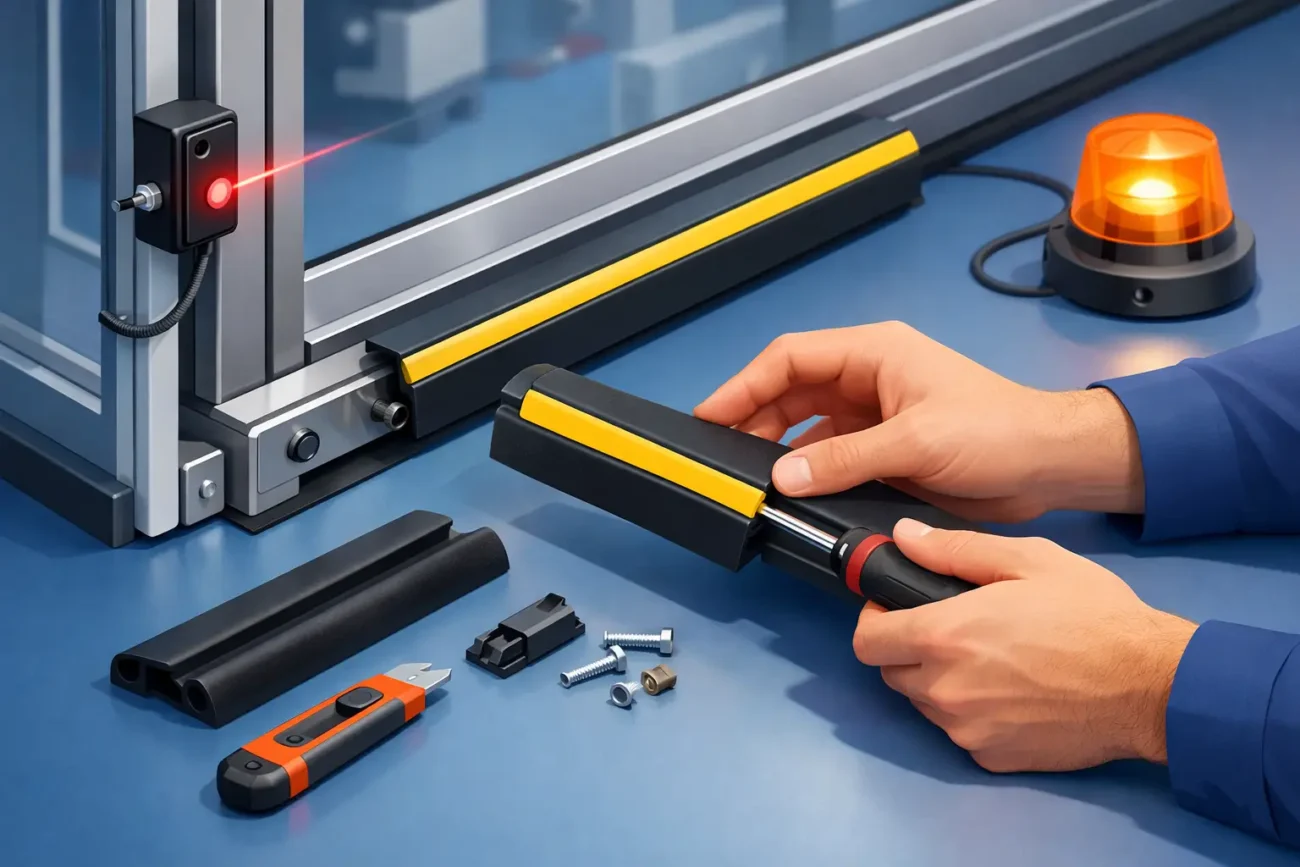
Photocells, induction loops, radar sensors and safety edges are not interchangeable just because they perform a similar job. Safety category, detection range, mounting environment and output type all need checking. If the door is part of a compliance-sensitive environment, the replacement needs to meet the same functional requirement as the original.
Encoders and limit devices
These are often overlooked until a door starts travelling erratically, stopping short or losing position. Encoders need the correct pulse output and connector type. Mechanical and digital limit systems are not automatically swappable. One incorrect assumption here can leave the door unusable.
New, old or obsolete – what to do when the part is hard to find
Older industrial doors are still in service across warehouses, factories and service yards throughout the UK, and many of them rely on components that are no longer listed by general suppliers. That does not always mean a full replacement is necessary.
Sometimes the original part is still available but under a revised number. Sometimes there is a manufacturer-approved substitute. In other cases, there may be a retrofit option that keeps the door operating safely without replacing the full system. The trade-off is that retrofits can involve extra labour, rewiring or setting changes, so the cheapest part on paper is not always the lowest total cost.
This is where technical support has real value. If you are dealing with a worn label, a discontinued board or a motor with no obvious reference, a supplier with experience in hard-to-find spares can often identify it from photos and measurements. That is usually faster than trial and error, and much cheaper than shelving multiple wrong parts.
Price matters, but downtime usually matters more
Everybody wants a fair price, and rightly so. But with industrial door systems, part cost is only one piece of the decision. If a loading bay door is out of action, the knock-on cost can be far higher than the difference between a bargain part and the correct one supplied quickly.
There is also the question of part quality. A lower-cost replacement may be acceptable for some accessories, but for safety devices, controllers and high-cycle operators, reliability should come first. Cheap substitutes can create nuisance faults, reduced lifespan and extra callouts. On safety-critical systems, they can create bigger problems than the original fault.
The better approach is to weigh price against compatibility, lead time and support. If a supplier can confirm the exact part, advise on any alternatives and dispatch promptly, that service often saves more than it costs.
What information to have ready before ordering
Any industrial door parts buying guide should come down to practical details. The more precise your information, the quicker the part match.
Try to gather the manufacturer name, door type, model number, serial number, voltage, photos of the failed part and photos of the full installation. If there is a fault code, include it. If wiring has already been disturbed, say so. If the part has dimensions that matter, measure them. If the issue followed impact damage, water ingress or a power event, mention that too.
This matters because two faults that sound similar can point to very different components. “Door not closing” could mean a failed photocell, a damaged edge, an encoder fault, a control setting issue or a motor brake problem. Good information shortens that path considerably.
When to replace one part and when to rethink the system
There are cases where replacing a single component is sensible and cases where it is only delaying a larger problem. If the door is otherwise sound and the failed part is current, replacing the part is usually the right move. If multiple components are ageing, boards are obsolete and reliability is slipping month by month, it may be worth assessing whether a broader upgrade is more economical.
That does not mean replacing the whole door every time a part becomes awkward to source. It means looking honestly at usage, safety requirements and repeat maintenance costs. A site with heavy daily cycles may be better served by planned upgrades than emergency callouts every few weeks.
For buyers who are not sure where that line is, this is where a specialist supplier can help with a practical view rather than a sales pitch. Sometimes the answer is a single replacement sensor. Sometimes it is a motor and board package. Sometimes it is advice to stop spending money on a setup that has reached the end of its useful life.
Door Spares UK Ltd sees this every day, especially where customers need exact-fit parts quickly and cannot afford guesswork. The fastest order is not always the best order. The right one is.
If you are buying industrial door parts, think like a troubleshooter first and a buyer second. A clear photo, a proper model reference and a bit of technical context can save hours, spare repeated failures and get the door back to doing its job.


Leave a comment