


A door that opens too late, stays open too long, or reacts to the wrong movement is not just irritating – it is a safety issue, an access issue, and often a callout waiting to happen. A pedestrian automatic door sensor sits at the centre of that problem. If the sensor is wrong for the entrance, badly positioned, or starting to fail, the whole system feels unreliable.
For facilities teams, engineers, and installers, that usually means complaints from users, wasted site time, and pressure to get the exact part quickly. For property owners, it often starts with a simple question: why is the door behaving oddly? The answer is not always the operator. Quite often, the sensor is the first place to look.
What a pedestrian automatic door sensor actually does
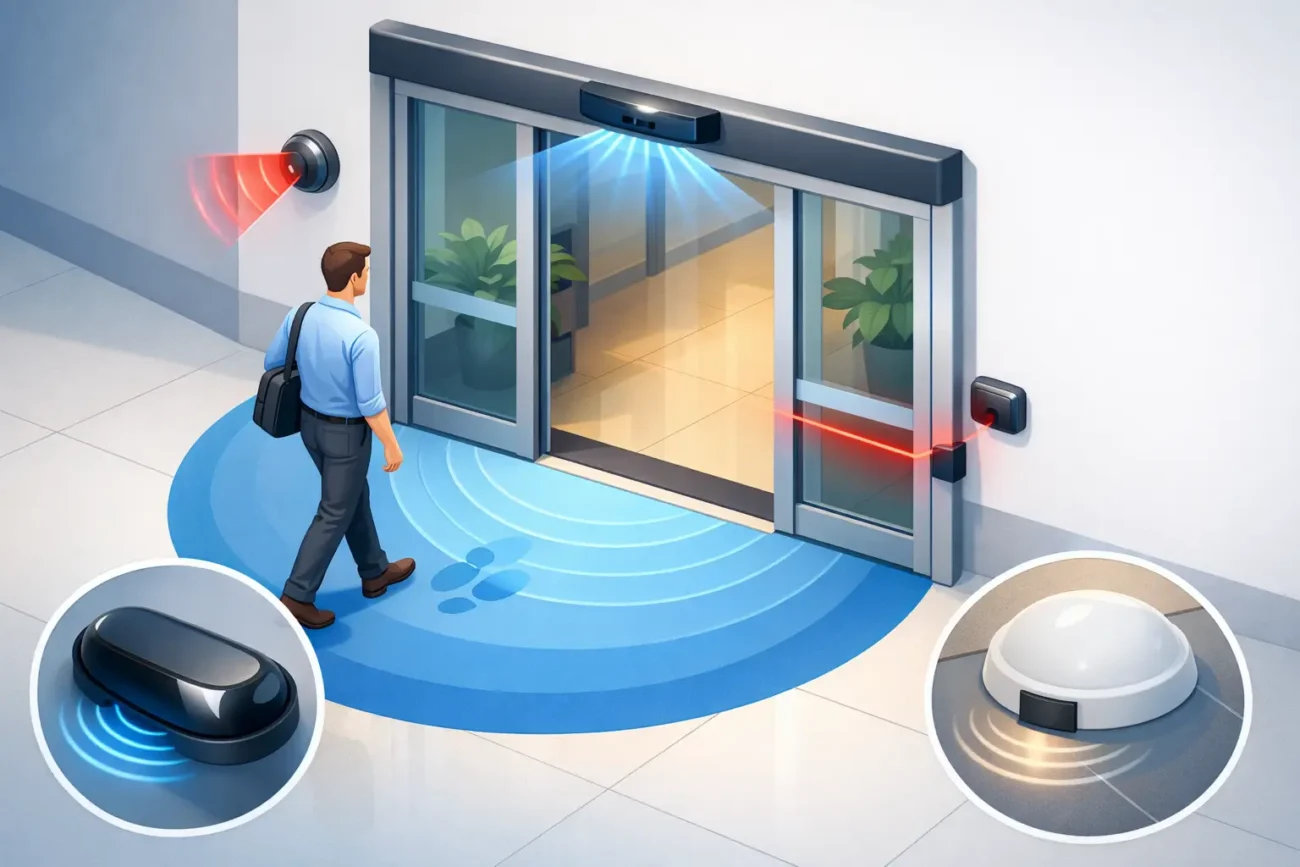
A pedestrian automatic door sensor detects people approaching, moving through, or standing within a door zone so the entrance can open and close safely. Depending on the application, it may be responsible for activation, presence detection, or safety monitoring. Those sound similar, but they are not the same job.
An activation sensor tells the door to open when someone approaches. A presence or safety sensor helps stop the door closing on a person in the threshold area. On some systems, separate devices handle those functions. On others, one combined unit covers more than one task. That distinction matters when you are replacing a faulty part, because matching the mounting style alone is not enough.
If a site has sliding doors at a shop entrance, swing doors in a healthcare setting, or an internal office access point, the sensor requirements can differ quite a bit. Traffic speed, approach angle, door leaf movement, surrounding light, and even reflective floor finishes can affect performance.
Types of pedestrian automatic door sensor
Most pedestrian door sensors used in commercial settings fall into a few familiar categories. Microwave sensors are common for activation. They detect motion and are useful where you need reliable opening on approach. They can, however, be too sensitive if poorly adjusted, especially where passing traffic or nearby movement sits close to the detection zone.
Infrared sensors are often used for presence and safety. They create a monitored area near the threshold and help prevent the door closing on a person or object. These are especially important where users may pause in the opening, move slowly, or use mobility aids.
Combined microwave and infrared units are widely used because they can cover both activation and safety functions in one housing. They save space and can simplify some installations, but they are not automatically the right answer for every operator or entrance layout. In replacement work, compatibility with the control board and existing wiring is always worth checking before ordering.
There are also specialist sensors for swing doors, escape routes, and more demanding public environments. A sensor that works well on one entrance can perform badly on another if the door type or approach pattern is different.
Why sensor choice matters more than many people think
It is easy to treat a sensor as a small accessory, but in practice it affects safety, compliance, user confidence, and day-to-day wear on the door system. If the detection field is too narrow, users may have to break stride or wave at the door to trigger it. If it is too wide, the door may cycle constantly from adjacent movement.
That repeated cycling puts extra load on motors, operators, arms, rollers, and control components. Over time, a poor sensor setup can create secondary faults that look like mechanical wear but started with the wrong detection behaviour.
There is also the user experience side. In healthcare, education, retail, and public access buildings, people expect doors to react predictably. Delayed opening or premature closing can quickly become a complaints issue. On busy sites, it can become a risk issue.
Common signs a pedestrian automatic door sensor is failing
Some faults are obvious. The door does not open unless someone gets very close. The door opens randomly with nobody at the entrance. The door starts to close while someone is still in the threshold. Those are all clear warning signs.
Other issues are less dramatic. Intermittent activation is common, particularly where the sensor lens is dirty, internal settings have drifted, the bracket has shifted, or environmental conditions have changed. A recently polished floor, a new matwell, stronger daylight, or nearby footfall can all alter how a sensor behaves.
Engineers will also recognise the problem where a door operator appears faulty but the root cause turns out to be the sensor signal. Before replacing major components, it is worth checking power supply, relay output, field setup, mounting angle, and any visible damage to the sensor body or cable.
What to check before replacing a sensor
The first check is function. Is the existing unit providing activation, safety, or both? Replacing a combined unit with a simpler motion-only sensor can leave the door unsafe. Replacing a safety sensor with something physically similar but electrically different can create ongoing faults or prevent correct commissioning.
The second check is compatibility. Voltage, output type, monitoring requirements, mounting height, and control interface all matter. Brand and model matter too, particularly on automatic pedestrian operators where settings and sensor behaviour are often tuned to the door controller.
The third check is environment. External entrances face rain, temperature swings, reflected light, and variable traffic. Internal doors may deal with narrower approach zones and more controlled conditions. A warehouse office entrance, a care home corridor, and a retail shopfront do not ask the same things of a sensor.
This is where accurate part identification saves time. If you have a model number, label photo, or even a picture of the installed unit and connector, you are already in a better position than trying to guess from appearance alone.
Installation and adjustment are half the job
Even the right part can perform badly if it is mounted or set up poorly. Detection field angle, height, and sensitivity all affect the result. A few degrees too far forward or too wide to one side can make the system unreliable.
That is especially true on swing doors, where the moving leaf creates a different risk profile from sliding doors. Sensors need to account for the sweep area and user position. On high-traffic entrances, fine adjustment is often what separates a nuisance door from one that works properly every day.
Clean installation also matters. Loose fixings, poor cable routing, and contaminated lenses create faults that look electrical but are often avoidable. If a door environment is dusty or exposed, regular inspection should be part of maintenance rather than something left until users start complaining.
When repair is sensible and when replacement is better
Sometimes the issue is simple. A dirty lens, a moved bracket, a damaged cable, or incorrect settings after previous works can often be put right without replacing the sensor. If the unit is relatively current and the fault is clearly external, repair or re-setup may be the sensible option.
If the housing is cracked, the detection is inconsistent, the electronics are ageing, or the part is obsolete, replacement is usually the better call. Chasing an intermittent sensor fault can cost more in labour than fitting the correct new unit from the start.
Obsolescence is a common headache on older entrances. Manufacturers change ranges, connectors, and setup methods. That does not always mean the whole operator needs replacing, but it does mean part matching needs care. This is often where specialist supply support makes a real difference, particularly if the original label is worn or missing.
Getting the right part without wasting site time
The quickest route is usually the most precise one. Start with the make and model of the door operator if known, then the sensor part number, then clear photos of the installed unit, fixing position, cable entry, and connector. If the symptom is unusual, note exactly what the door is doing and when.
That detail helps narrow down whether the fault points to activation, safety monitoring, control input, or setup. It also reduces the risk of ordering a near match that looks right but will not work correctly on site.
For buyers who are not engineers, this is where a supplier with practical product knowledge is worth having. Door Spares UK Ltd deals with these part-identification problems every day, and sometimes a good photo tells more than a vague model description ever will. If you are stuck, Ask Dora is there for exactly that reason.
A sensor is a small part with a big job
People rarely notice an automatic door sensor when it is working properly. They notice it the moment it is not. For anyone responsible for access, safety, or building uptime, that makes sensor choice and replacement more than a box-ticking exercise.
Get the function right, match the part properly, and pay attention to setup. That usually means fewer nuisance faults, fewer repeat visits, and a door that behaves as it should – safely, consistently, and without drama.

Leave a comment