


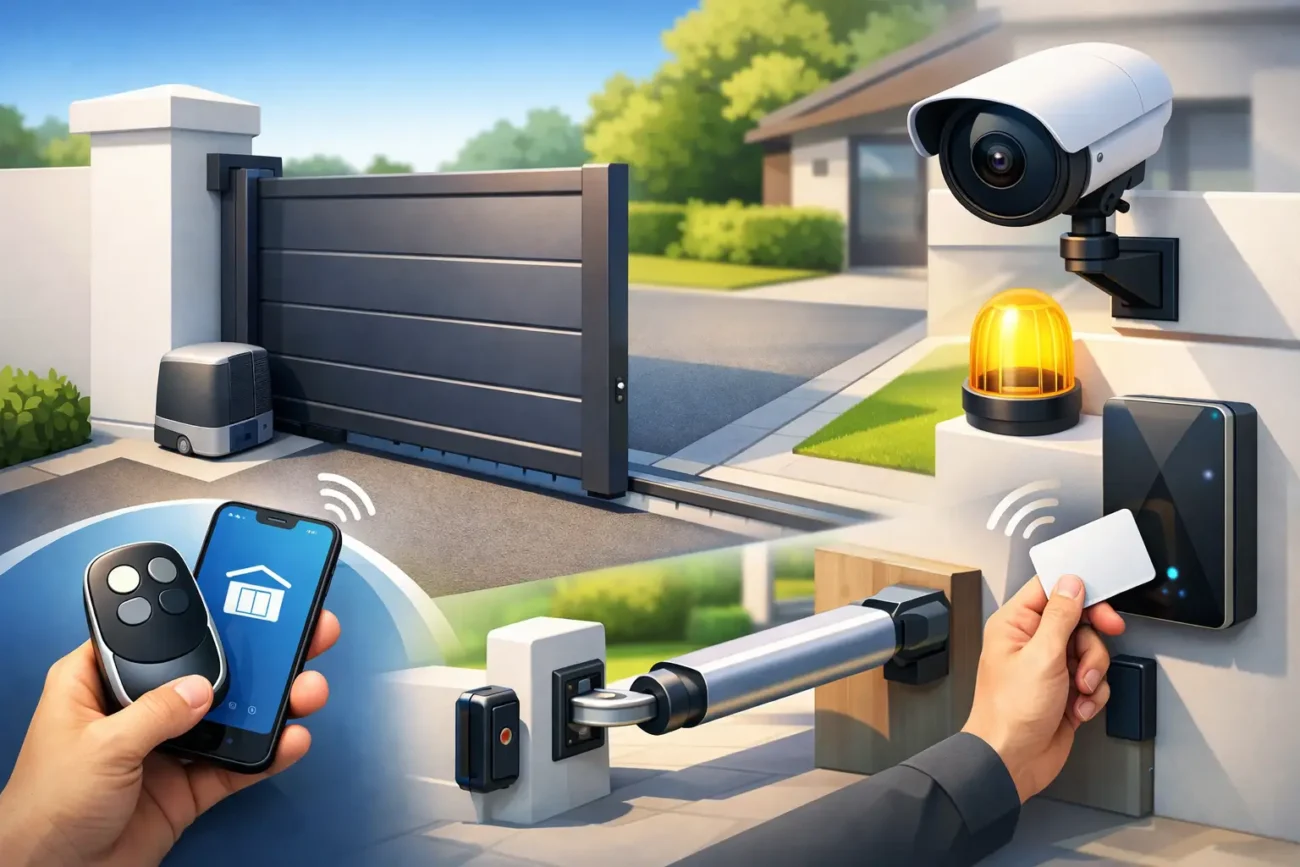
A gate that opens late, stops halfway or refuses to respond at all is more than a nuisance. On a commercial site it can hold up deliveries, frustrate staff and leave a perimeter less secure than it should be. That is why gate automation systems need to be chosen with the same care as any other access control equipment – with attention to duty cycle, safety, control logic and the availability of the right replacement parts.
What gate automation systems actually include
People often use the term as if it only means a motor. In practice, gate automation systems are made up of several working parts that all need to match the gate itself and the way the site operates.
The operator is the obvious starting point, whether that is a ram, articulated arm or sliding gate motor. But the rest of the system matters just as much. Control boards, safety photocells, loop detectors, warning lights, keypads, radio receivers, intercoms, locks and manual release mechanisms all play a part in day-to-day reliability.
This is where poor specification usually starts. A site may have a sound motor but the wrong safety devices, an ageing control panel or access controls that do not suit actual traffic flow. When that happens, the system works on paper but not in the real world.
Matching the system to the gate
The first question is not which brand to buy. It is what the gate is asking the automation to do.
A lightweight domestic swing gate opening a few times a day has very different demands from a heavy steel gate on a busy industrial entrance. Weight, leaf length, hinge geometry, wind exposure, ground conditions and frequency of use all affect what operator will perform well over time.
For swing gates, underground motors can offer a cleaner appearance, but they are not always the easiest to service later on. Above-ground rams and articulated arms are often more practical where maintenance access matters and where reliability takes priority over a concealed finish.
For sliding gates, the focus shifts to track condition, gate weight, run length and how clean the running area stays. A motor may be correctly rated, but if the gate track fills with debris or the rollers are worn, the automation will still struggle. That is why the gate structure and mechanical condition should never be treated as separate from the automation.
Safety is not the add-on
If there is one area where shortcuts cause long-term problems, it is safety. A proper automated gate setup needs more than opening and closing force. It needs protection for the people and vehicles using it.
Photocells are standard, but one pair is not always enough. The layout of the entrance, the gate type and the risk points around travel zones all affect what protection is needed. Safety edges may be required on leading edges, hinge areas or crush points. Flashing lights, audible warning and emergency stop options can also be relevant depending on the site.
This is also where maintenance teams often run into avoidable faults. A gate may be blamed for unreliable operation when the actual issue is a misaligned photocell, damaged cabling or water ingress in a safety device. The control board only reacts to the signals it receives. If one component is compromised, the whole system becomes unpredictable.
Control methods depend on the site
Not every entrance should be opened the same way. One of the most common mistakes with gate automation systems is choosing controls for convenience in the short term rather than suitability over the long term.
A private property might be well served by remote transmitters and a simple keypad. A shared residential block may need fobs, audio entry and timed access. A warehouse, distribution yard or service entrance might need loop detectors, GSM entry, access control integration or separate command logic for staff and visitors.
The right answer depends on traffic type and traffic volume. If delivery vehicles queue regularly, opening speed and hold-open timing matter. If there is mixed pedestrian and vehicle use, the control strategy needs to reflect that. If security is the main concern, credential management and event control become more important than sheer opening speed.
Reliability comes from the small details
Most recurring faults are not dramatic component failures. They are the small issues that build up until the gate becomes unreliable.
Limit switches drift. Encoders fail. Control boards suffer from moisture or voltage problems. Photocells go out of alignment. Motors overheat because the duty cycle is too high for the installation. Receivers lose consistency. Manual release assemblies get neglected until nobody can operate them properly during a power cut.
This is why parts support matters as much as the original install. On a busy site, downtime is rarely about whether a component can be replaced eventually. It is about whether the correct part can be identified quickly and supplied without guesswork. For older systems especially, that can mean matching boards, motors, sensors and accessories by image, markings or application rather than relying on a complete model reference.
New installation or repair – it depends
There is no single rule for when to replace an entire setup. Sometimes a targeted repair is the sensible option. Sometimes it is false economy.
If the gate is structurally sound, the operator is suitable for the application and the fault is isolated to one known part, repair usually makes sense. Replacing a failed control board, safety photocell, receiver or motor component can restore performance without the cost of a full new system.
If faults are becoming frequent across multiple components, if safety compliance is questionable or if the existing automation was underspecified from the start, replacing the system may be the better long-term decision. That is particularly true where spare parts for legacy equipment are hard to source or where repeated call-outs are already costing more than planned replacement.
A practical assessment should look at the whole setup – mechanics, controls, safety devices and expected usage. Replacing the visible operator alone does not solve much if the real problem sits elsewhere.
What buyers should compare before they commit
Brand matters, but specification matters more. A known name does not automatically mean the product is right for the entrance in front of you.
Start with gate type, dimensions and usage level. Then look at operator force, duty cycle, ingress protection, manual release design and compatibility with the controls and safety devices you need. For commercial settings, future serviceability should be part of the decision as well. If a board, encoder or receiver fails two years on, you want a setup that can be supported without delay.
It is also worth looking beyond the core automation kit. If the site already uses barriers, pedestrian automatic doors or other access systems, integration may matter. A gate should not become an isolated bit of equipment that creates extra management work.
For trade professionals, this often comes down to reducing time on site later. For facilities teams and owners, it means fewer operational surprises and clearer maintenance planning.
Support matters when the model number is gone
In the field, parts identification is not always tidy. Labels fade, old paperwork disappears and different installers may have altered systems over time. That is when technical support becomes genuinely useful, not just a sales extra.
A specialist supplier can often identify components from photos, layout, dimensions or symptoms, which is far more helpful than telling a customer to find a serial plate that no longer exists. For engineers under pressure and property owners who are not sure what they are looking at, that kind of support saves time and reduces ordering mistakes.
This is where a practical service approach stands out. Door Spares UK Ltd works with customers who know the exact part number and with those who only know that the gate stopped working on Tuesday afternoon and the site needs access restored quickly. Both situations are common.
Maintenance is what keeps automation sensible
Even a well-specified system will not stay reliable without routine checks. Gates live outdoors, deal with dirt and water, and put moving parts under repeated load. That means regular inspection is not optional if the gate is expected to perform consistently.
A sensible maintenance routine covers mechanical wear, fixing security, travel force, safety device operation, control response and signs of moisture or cable damage. The point is not to create paperwork for its own sake. It is to catch the small faults before they become a breakdown, a safety issue or a denied entry problem at the worst possible moment.
If your gate is opening more slowly, reversing without reason, failing intermittently or making more noise than it used to, those are early warnings worth acting on. Waiting until total failure usually turns a straightforward parts job into a larger repair.
The best gate automation systems are not necessarily the most complex or the most expensive. They are the ones that suit the gate, the site and the level of use, with parts and support available when something eventually wears out. Choose with that in mind, and the gate becomes one less thing to chase when the day is already busy.

Leave a comment