


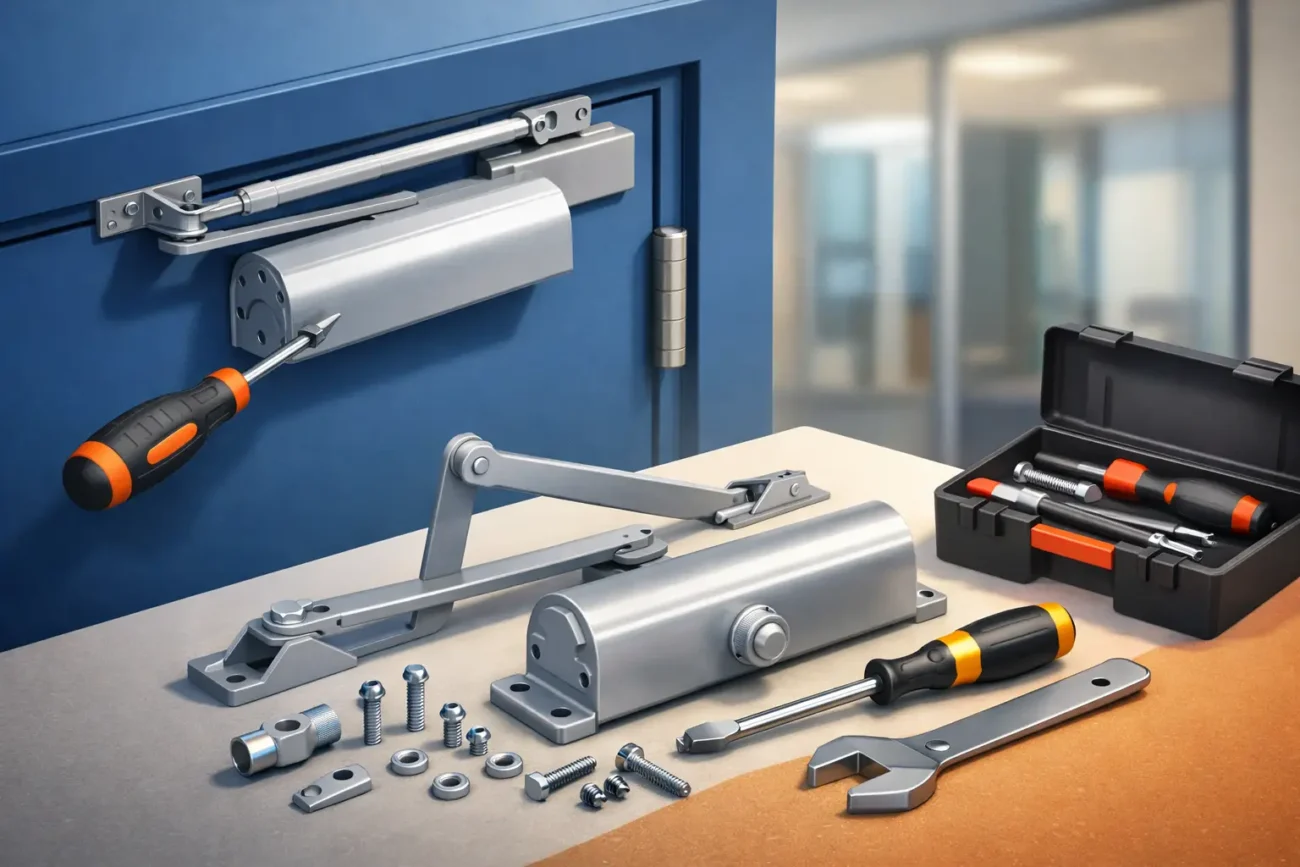
A door that slams, drifts open, or needs a shoulder barge to shut properly is more than an annoyance. In most commercial settings, it is a safety issue, a compliance risk, and a sign that commercial door closer replacement should be dealt with before it turns into a bigger problem.
A worn closer affects how the whole entrance performs. Staff notice it first because the door feels wrong. Facilities teams notice it when complaints start stacking up. Engineers notice it when adjustment screws no longer bring the door back under control. Once a closer is leaking oil, failing to latch, or pulling the arm out of alignment, replacement is often the sensible route.
When commercial door closer replacement is the right call
Not every faulty closer needs changing straight away. Some units can be adjusted, re-fixed, or paired with a replacement arm set if the main body is still sound. But there is a point where repair stops being cost-effective.
If the closer body is leaking hydraulic fluid, the internal seals have usually failed. At that stage, the unit will rarely hold a consistent closing speed for long. If the door is not latching unless someone pushes it, the spring may have weakened or the closer may be undersized for the door leaf. If the fixing points are distorted or the arm is bent, it is worth checking whether the door has been overextended, incorrectly installed, or subjected to abuse. Replacing the closer without addressing that underlying issue can lead to the same failure again.
There is also the question of fire doors. On a fire-rated opening, the closer is part of the door set’s overall performance. A door that does not close fully and reliably is not doing its job. In those cases, delay is rarely worth the risk.
What causes a commercial door closer to fail?
Most failures come down to wear, misuse, poor specification, or exposure. A closer fitted to a heavy traffic entrance may simply reach the end of its working life. That is normal. Other failures happen because the original unit was never right for the door size, weight, or usage level.
External doors are especially demanding. Wind pressure, temperature changes, and frequent use all put extra strain on the mechanism. A closer that performs acceptably on an internal office door may struggle badly on a main entrance or service access point. Add poor maintenance, loose fixings, or a frame that has shifted over time, and the closer ends up doing more work than it was designed for.
Hold-open misuse is another common issue. People wedge doors open with bins, fire extinguishers, or timber offcuts, then wonder why the arm geometry fails. That is not a product fault. It is site behaviour, and it matters when choosing a replacement.
Matching the replacement properly
This is where many problems start. Commercial door closer replacement is not just a case of ordering the same shape of box and hoping for the best. The closer must suit the door, the frame, the traffic level, and the opening conditions.
The first step is identifying what is already fitted. That sounds simple until you find an old closer with no visible label, a non-standard arm, or a body drilled to an unusual template. If a product code is still visible, that helps. If not, dimensions, fixing hole positions, arm type, and a clear photo usually narrow it down quickly.
Door width and weight matter because they affect power size. A weak closer on a wide or heavy door will struggle to latch, especially against seals or air pressure. An oversized closer can make the door unnecessarily hard to open and create accessibility problems. That balance matters in schools, care settings, offices, communal entrances, and any building with mixed users.
You also need to consider mounting type. Surface mounted closers are the most common, but even within that group there are regular arm, parallel arm, and transom fixing arrangements. Some doors need slide arm sets for reduced projection or aesthetic reasons. Others may need backcheck, delayed action, or specific fire door certification. If the opening is exposed, corrosion resistance and consistent performance in changing temperatures become part of the decision too.
Commercial door closer replacement on fire doors
Fire doors need extra care because the closer is a life safety component, not just a convenience item. The replacement should be compatible with the door’s fire rating and suitable for the way the opening is used.
That does not always mean like-for-like in a simple sense. Older units are sometimes obsolete, and a modern equivalent may be the better option if it meets the required standard and can be installed correctly. What matters is that the closer is capable of controlled, reliable self-closing on that specific door set.
Installers and responsible persons should also check the rest of the opening while they are there. If hinges are worn, seals are damaged, latch alignment is poor, or the frame is distorted, a new closer alone may not solve the closing issue. A fire door works as a system. Treating one symptom in isolation often leads to callbacks.
Repair or replace – the practical decision
The honest answer is that it depends on the fault and on the age of the unit. If the arm screw has loosened, fixings have pulled slightly, or speed settings have drifted, repair may be perfectly reasonable. If the closer body has failed internally or parts are unavailable, replacement is normally faster and more reliable.
For maintenance teams, time matters as much as parts cost. A cheaper short-term fix can become expensive if it means a second visit, repeated complaints, or a non-compliant door left in service. On a busy site, downtime has a cost of its own.
That is why technical identification is so useful. A good supplier should be able to look at the existing closer, the door details, and the symptoms, then steer you towards a unit that fits the job rather than just the old fixing marks. Sometimes that means a direct replacement. Sometimes it means a better specified alternative.
What to check before ordering
Before you order, gather the basics. The closer make and model are ideal, but not always available. Door width, whether it is internal or external, the arm arrangement, and whether it is a fire door all help. So do photos of the closer body, arm, and fixing area.
It is also worth noting the fault clearly. Is the door slamming, not latching, leaking, sticking, or failing to close from a certain angle? Those details point to whether the issue is the closer itself or something else on the opening.
If you are replacing multiple closers across a site, consistency can help future maintenance. Standardising where possible makes adjustment, stocking, and servicing easier. The trade-off is that one model does not suit every opening, so standardisation should never override correct specification.
Why exact-fit support matters
Anyone who has dealt with obsolete or unlabelled hardware knows the problem. You can waste hours comparing product photos, only to end up with the wrong unit and another delay on site. That is where hands-on parts support earns its keep.
For trade professionals, fast identification reduces return visits and keeps labour under control. For end users and facilities teams, it removes guesswork. If all you have is a few photos and rough measurements, that should still be enough to start the conversation. Door Spares UK Ltd handles this sort of part-matching every day, which is exactly why services like Ask Dora are useful when the part number has long since disappeared.
Getting the result you actually need
A successful commercial door closer replacement is not just about making the door close again. It is about restoring safe, controlled operation that suits the building, the people using it, and the demands of the opening.
That may mean choosing a closer with better power adjustment, a more suitable arm arrangement, or fire-rated certification for the application. It may also mean recognising that the closer is only part of the problem and dealing with worn hinges, alignment issues, or abuse on site.
If the door is critical to safety, security, or day-to-day operations, the cheapest answer is rarely the best one. The right closer, identified properly and matched to the opening, saves time and trouble later.
When a door starts telling you something is wrong, it is worth listening early. A closer is a small component, but when it fails, everyone notices.

Leave a comment