


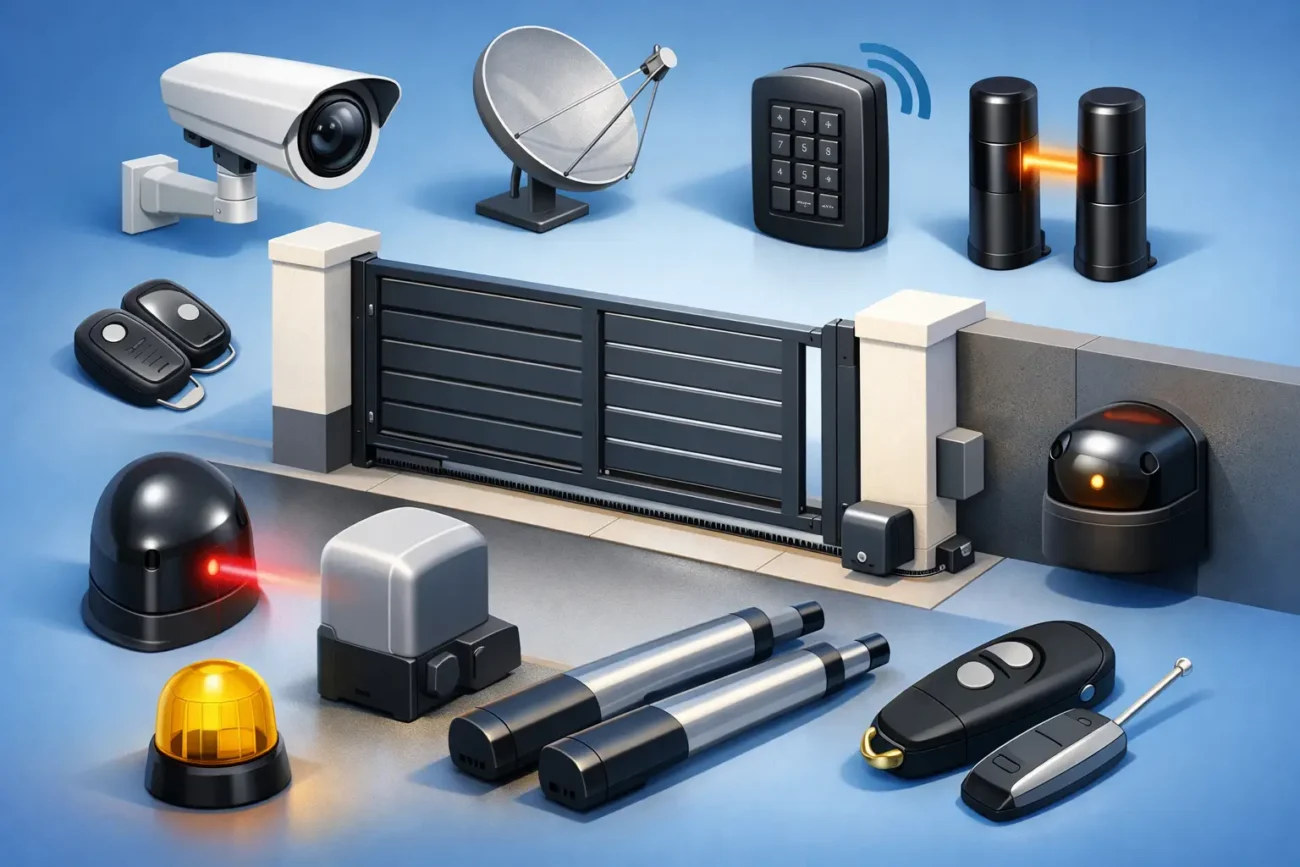
A gate motor gets most of the attention, right up until the day a site call-out turns out not to be the motor at all. More often, the problem sits with the accessories around it – the safety edge that has failed, the photocells knocked out of line, the receiver with patchy range, or the control board enclosure taking on water. When customers ask about the top automatic gate accessories, they are usually trying to solve one of three things: safety, reliability, or easier day-to-day access.
That is the right way to look at it. Accessories are not add-ons in the casual sense. On a busy commercial entrance, a shared residential gate, or a private driveway exposed to British weather, the right supporting components can make the difference between a gate that behaves properly and one that creates repeat faults.
What makes the top automatic gate accessories worth buying?
The best accessories do one clear job well and stand up to the conditions they are fitted in. That might mean protecting pedestrians, giving delivery drivers dependable access, or stopping nuisance breakdowns caused by voltage issues or water ingress. Fancy features have their place, but most buyers are better served by parts that improve safety, control and durability first.
It also depends on the gate type and usage. A pair of swing gates on a domestic drive has different demands from a sliding gate serving a warehouse yard. Traffic frequency, exposure to rain, user behaviour and cabling routes all affect what counts as worthwhile.
Safety accessories come first
If there is one category that should never be treated as optional, it is safety. Automatic gates move with force, and that means detection and protection devices need to be right.
Photocells and safety beams
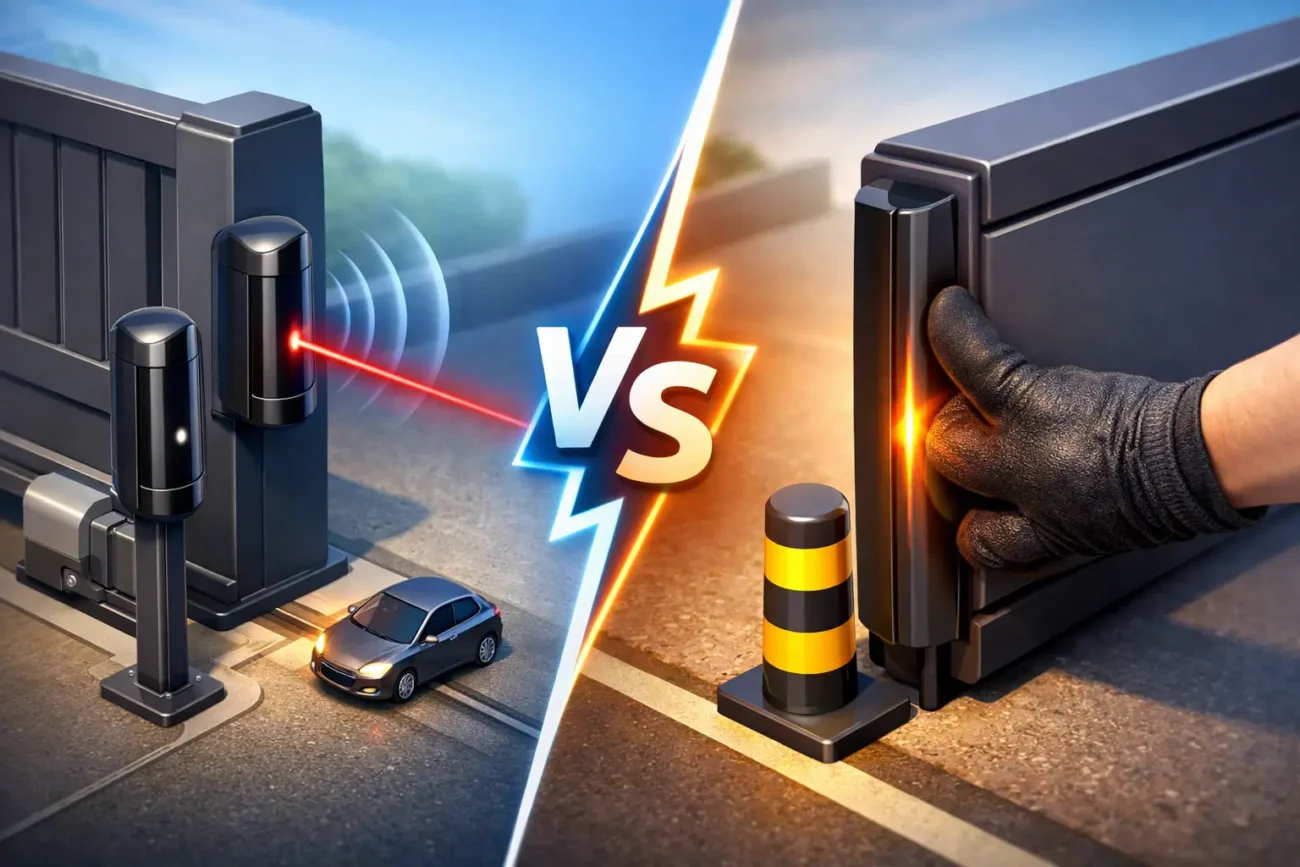
Photocells are among the most common and most useful accessories on any automated gate. They create a detection line that tells the system when a vehicle, person or object is in the gate path. When aligned properly and kept clean, they are simple, dependable and cost-effective.
Where things go wrong is usually not the technology itself. It is poor placement, accidental knocks, dirty lenses or moisture getting into housings. On exposed sites, choosing a well-sealed set and fitting them where they are less likely to be clipped by mirrors or trolleys is often more important than chasing a premium model with features you will not use.
Safety edges
A safety edge adds contact protection, usually on the leading edge of a moving gate or on crush points where there is a risk of entrapment. If the edge is triggered, the system stops or reverses. On many installations, especially those with public access or tighter closing areas, this is essential rather than desirable.
Wireless safety edge systems can be very useful where cabling is awkward, particularly on swing gates. The trade-off is battery maintenance and the need to make sure signal integrity remains stable over time. Hard-wired setups reduce battery concerns but can be more involved to install neatly.
Flashing warning lights
Warning lights are easy to dismiss, but they do a straightforward job that matters. They give a clear visual signal that the gate is in motion and help alert pedestrians, visitors and drivers unfamiliar with the entrance. On darker sites or entrances with poor sight lines, they are a sensible addition.
Access control accessories that reduce daily friction
Once safety is covered, the next priority is usually control. A gate that opens reliably for the right users and stays closed to everyone else saves time and avoids hassle.
Top automatic gate accessories for access control
Remote controls and radio receivers
Hand transmitters remain one of the most common access methods for domestic and light commercial gates. They are convenient, quick to issue and easy to replace. If you are managing multiple users, the important thing is not just the fob itself but the receiver compatibility, range and ease of adding or removing users.
In busy environments, poor receiver position can create more complaints than a faulty transmitter. Metal cabinets, structural steel and long distances can all affect performance. A well-placed aerial or upgraded receiver can sometimes solve what looks like a bigger system problem.
Keypads and coded entry
A keypad suits shared access points well, especially where users come and go without needing a physical fob. Trades, staff, tenants and approved visitors can all be managed through codes, and changing a code is easier than recovering lost remotes.
The drawback is obvious. Codes get shared. On sites with higher turnover or tighter security requirements, a keypad works best when combined with time-limited codes, audit functions or another access layer rather than as the only form of control.
Intercoms and GSM entry systems
Intercoms are useful where someone needs to authorise access remotely. GSM systems are especially practical where running extra cables is difficult, because they use the mobile network rather than relying entirely on hard-wired voice points. For gated properties, depots and smaller commercial sites, this can be a tidy solution.
Signal strength matters, though. A brilliant unit in a poor coverage area is still a poor setup. Before specifying one, it is worth checking reception properly rather than assuming the network will be fine because a mobile phone worked there once.
Vehicle detection loops and exit sensors
Free-exit loops and ground detection systems are often overlooked until users get tired of waiting to trigger a manual exit. On sites where vehicles regularly leave without needing authorisation, a loop can speed traffic flow and reduce gate wear caused by unnecessary stop-start cycles.
The installation work is more involved than fitting a remote receiver or keypad, so this tends to make most sense on higher-use gates rather than occasional-use domestic systems.
Reliability accessories that prevent avoidable faults
A gate can have the right motor and still behave badly if the supporting electrical and control components are weak or badly matched.
Control boards and logic cards
A control board is not glamorous, but it is central to how the gate behaves. Opening times, obstacle response, lock timing, accessory inputs and fault monitoring all depend on it. If a board is failing or the wrong specification for the system, you can end up chasing intermittent problems for weeks.
Matching the correct board or compatible replacement is crucial. Brand, model, voltage and accessory setup all matter. This is where accurate identification saves a lot of wasted time and unnecessary returns.
Battery backup and power management
Mains failures are not everyday events everywhere, but when they happen the gate still needs a plan. Battery backup is particularly useful on entrances where access cannot simply stop, such as business premises, managed sites or properties where vehicle access is safety-critical.
Not every system needs it, and not every backup setup delivers long operating time. The point is less about endless cycling during an outage and more about controlled operation, secure closure or enough movement to avoid users being stranded.
Surge protection and enclosures
Power fluctuations and water ingress are two common causes of avoidable failures. Surge protection can be a sensible step on exposed sites or areas with known electrical instability. A decent enclosure, proper cable glands and tidy sealing are equally important. There is no value in fitting quality electronics into a setup that leaves them vulnerable to damp.
Security accessories that do more than close the gate
Automation controls movement, but accessories often provide the extra layer that turns a gate into a stronger perimeter measure.
Magnetic locks and electric locks
On swing gates especially, locking hardware can improve holding force and help resist wind load or forced opening. The correct lock depends on gate design, usage and motor type. Fit the wrong one and you can create alignment headaches or strain the automation.
Posts, brackets and mounting hardware
These are not exciting parts to order, but poor mounting causes endless trouble. Misaligned photocells, vibrating keypads and twisted limit devices often come back to weak brackets or badly chosen posts. In outdoor automation, the basic mechanical support matters just as much as the electrical component sitting on it.
Choosing accessories by site, not by catalogue
The right accessory package starts with the site conditions. A private driveway may only need quality photocells, a dependable pair of remotes and a warning light. A commercial yard may need monitored safety devices, vehicle detection, stronger access control and better protection for electrical components.
Usage patterns matter too. If dozens of people need access, issuing remotes to all of them may become messy and expensive. If the gate serves delivery traffic, fast and clear exit control will matter more than app-based novelty features. If the entrance is coastal or fully exposed, weather rating becomes a buying decision rather than a nice extra.
It is also worth thinking about serviceability. The cheapest accessory is not the cheapest if it fails early, has awkward programming, or cannot be matched easily when a replacement is needed. For engineers and facilities teams, parts that can be identified quickly and swapped with confidence are often the smarter long-term choice.
When compatibility is the real issue
A lot of gate accessory problems are compatibility problems in disguise. Mixing radio gear, control inputs, safety devices and boards from different generations or manufacturers can work, but it needs checking properly. Voltage, relay type, logic settings and physical environment all need to line up.
That is why technical support matters. A clear photo of the existing setup, the board label, the motor brand and the fault behaviour will often tell an experienced supplier more than a vague request for a universal part. If you are not sure, asking before ordering usually saves time.
The top automatic gate accessories are not the ones with the longest feature list. They are the ones that make the gate safer, easier to use and less likely to fail when it matters. Choose with the site in mind, not just the brochure, and you will end up with a system that works harder and causes fewer headaches.



Leave a comment