


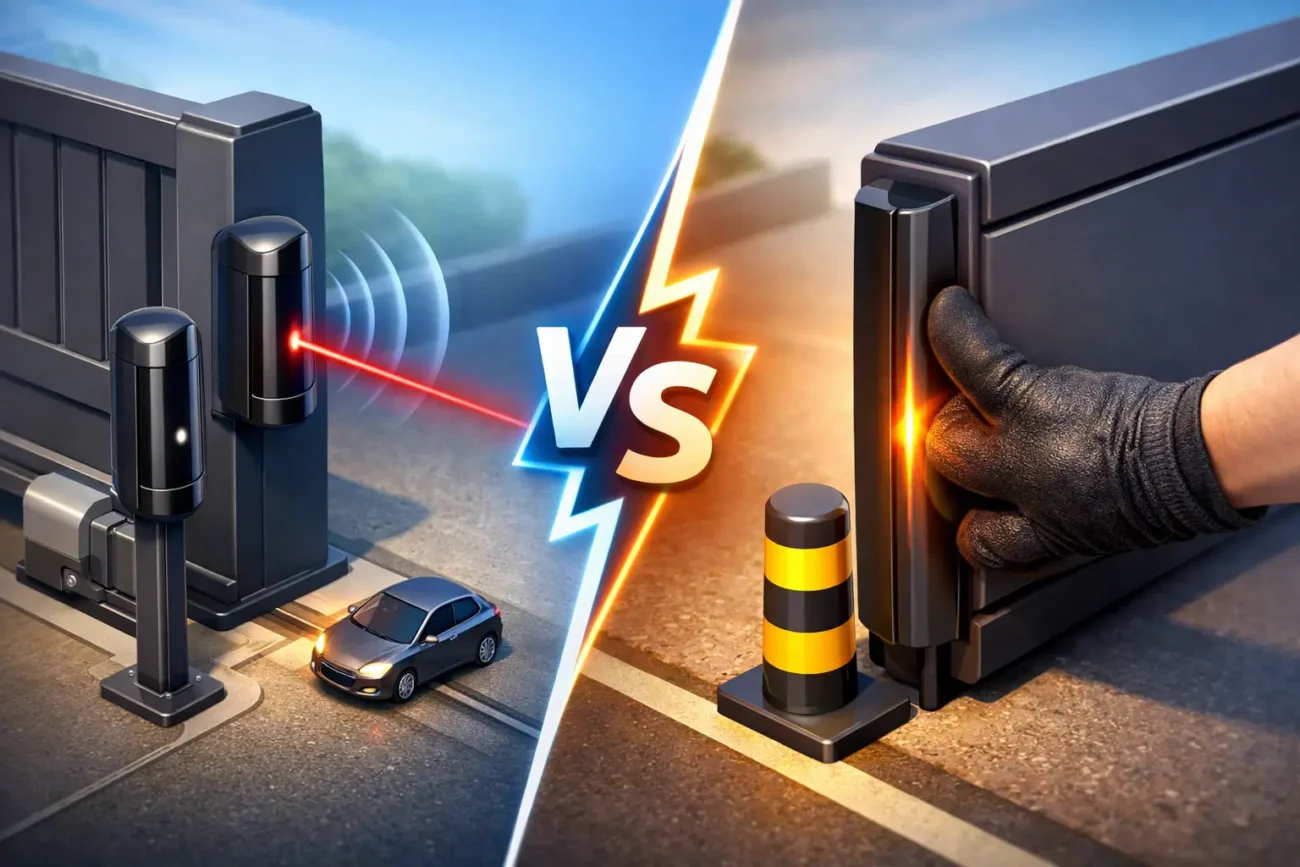
A shutter that stops short is annoying. A gate that keeps closing when a person, pallet lorry or vehicle is in the way is a safety risk, a liability issue and usually a sign the protection setup is wrong for the opening. When people compare photocells vs safety edges, they are often really asking a more practical question: what will actually stop this door or gate safely, reliably and with the least downtime?
The honest answer is that they do different jobs. In many cases, the right choice is not one or the other, but both.
Photocells vs safety edges – the basic difference
Photocells detect presence without contact. They create an invisible beam between a transmitter and receiver, and when that beam is interrupted, the control panel knows something is in the opening. That makes them a non-contact safety device, commonly used on sliding gates, industrial doors, barriers and some automated garage systems.
Safety edges work by contact. They are fitted to a moving edge such as the leading edge of a gate or the bottom edge of a powered door. If the edge meets an obstacle, it sends a signal to stop or reverse movement. In simple terms, a photocell tries to prevent impact before it happens, while a safety edge reacts at the point of contact.
That distinction matters because the hazard is not always in the same place. A photocell protects an area. A safety edge protects a specific moving edge.
Where photocells work well
Photocells are often the first thing installers and maintenance teams look at because they are effective, familiar and relatively straightforward to integrate into many control systems. If you need to detect a pedestrian crossing a gate opening, a vehicle entering a barrier lane, or a pallet moving through an industrial door, a correctly positioned photocell can do that before contact occurs.
They are particularly useful where there is regular traffic and you want the system to hold open or reverse before the moving equipment reaches the obstruction. For high-use commercial and industrial sites, that can reduce knocks, minimise wear and keep traffic moving.
Photocells also suit applications where contact is unacceptable. On a busy vehicle entrance, for example, waiting for a gate edge to strike a car before reacting is clearly not the best line of defence. A beam across the opening is far better at preventing that situation.
That said, photocells are only as good as their coverage. If the beam is too high, too low or too narrow for the real-world traffic using the opening, hazards can slip through. A forklift tine, a low trolley, a child, or part of a vehicle may not interrupt the beam in the way you expect. Alignment issues, dirt, weather exposure and accidental damage can also affect performance.
Where safety edges make more sense
Safety edges come into their own when the crushing or impact risk exists at the moving edge itself. Think of a sliding gate closing onto a post, or a roller shutter descending towards stock, equipment or a person. In these cases, the dangerous point is not just the opening – it is the actual edge creating the force.
A safety edge is designed for that exact hazard. When compressed, it triggers the system to stop or reverse. This gives direct protection at the point of risk, which is why they are widely used on powered gates, industrial doors and loading bay equipment.
They are also helpful where the opening geometry is awkward. A beam may not cover every pinch point or entrapment zone, especially on irregular or wider installations. A properly selected safety edge can be mounted where contact risk is most likely.
The trade-off is obvious enough: the system reacts when contact occurs. The edge is designed to minimise harm and respond quickly, but it still relies on a touch event. For some applications, that is acceptable as part of a wider safety design. For others, non-contact detection is needed first.
Why one device is rarely the whole answer
This is where photocells vs safety edges becomes less of a contest and more of a system design question. On many automated doors and gates, each device covers a weakness in the other.
Photocells can detect approach through an opening, but they may miss hazards outside the beam path or at the closing edge. Safety edges protect the leading edge directly, but they do not create a detection zone in front of the equipment. Used together, they give earlier detection and edge protection.
That layered approach is common on commercial sites because real use is messy. People do not always walk through the middle of an opening. Vehicles stop halfway. Deliveries overhang. Wind moves materials. Forklifts carry awkward loads. The more variable the environment, the less sensible it is to rely on a single safety measure.
Choosing the right setup for your application
The right answer depends on the type of automation, the traffic using it and the risk around it.
For sliding gates, photocells are often used to protect the clear opening, while safety edges protect the leading edge and other crush zones. On a busy commercial entrance, that combination is usually the safer and more dependable choice.
For roller shutters and industrial doors, safety edges are frequently essential on the bottom edge where the curtain closes down. Photocells may also be added where traffic flow is heavy or where early detection helps prevent nuisance stops and collisions.
For barriers, photocells are often more prominent because the aim is to detect vehicles or pedestrians in the lane before the arm closes. A safety edge may still be relevant depending on the barrier type and site risk assessment.
For domestic gates and garage automation, the same principles apply, but the environment tends to be less predictable in different ways. Children, pets and visiting drivers can make non-contact detection especially useful, while edge protection remains important where there is a real pinch or crush risk.
Common mistakes that cause trouble on site
The biggest mistake is assuming a photocell and a safety edge are interchangeable. They are not. Replacing one with the other without checking the original safety design can leave gaps in protection.
Another common issue is poor placement. A photocell installed in the wrong position may technically work but still fail to protect the most likely path of travel. Likewise, a safety edge fitted only to the obvious leading edge may leave secondary crush points unprotected.
Compatibility catches people out as well. Wireless and wired safety edges, resistive systems, monitored devices and different control boards all need to match the panel logic and the application. The wrong component can create faults, nuisance triggering or a system that will not commission properly.
Then there is maintenance. Dirty lenses, damaged cables, flat transmitter batteries and worn edges all affect reliability. A device can be present on the system and still not provide dependable protection if it is neglected.
Compliance, risk and real-world reliability
No responsible installer or site manager should choose between photocells and safety edges on price alone. Safety devices are part of the machine’s protective system, not optional extras added for convenience.
The correct setup should always reflect the hazards of the installation, applicable standards and the way the site is actually used. A warehouse entrance with mixed pedestrian and forklift traffic needs a different approach from a private driveway gate. A low-traffic opening may cope with a simpler arrangement. A high-cycle industrial door usually needs more thought.
Reliability matters just as much as specification. A cheaper part that fails in poor weather or drifts out of alignment can cost more in callouts and downtime than the better option would have done in the first place. For trade professionals, facilities teams and property owners, the practical test is simple enough: does it protect people, does it suit the control system, and will it keep working under site conditions?
So, which is better?
If you want early detection across an opening, photocells are often the stronger option. If you need protection at the moving edge where impact or crushing could occur, safety edges are the right device. If the installation has both kinds of risk, which many do, using both is usually the proper answer rather than an upgrade.
That is why specifying safety devices should never be guesswork. The opening type, control panel, site use and hazard points all need to line up. If you are replacing a failed component, it also helps to identify exactly what was fitted before and why. Even parts that look similar can behave very differently once connected.
When in doubt, slow the decision down long enough to get the part and the setup right. A door or gate that works safely every day is far less costly than one that keeps you chasing faults, failed inspections or avoidable incidents.



Leave a comment