


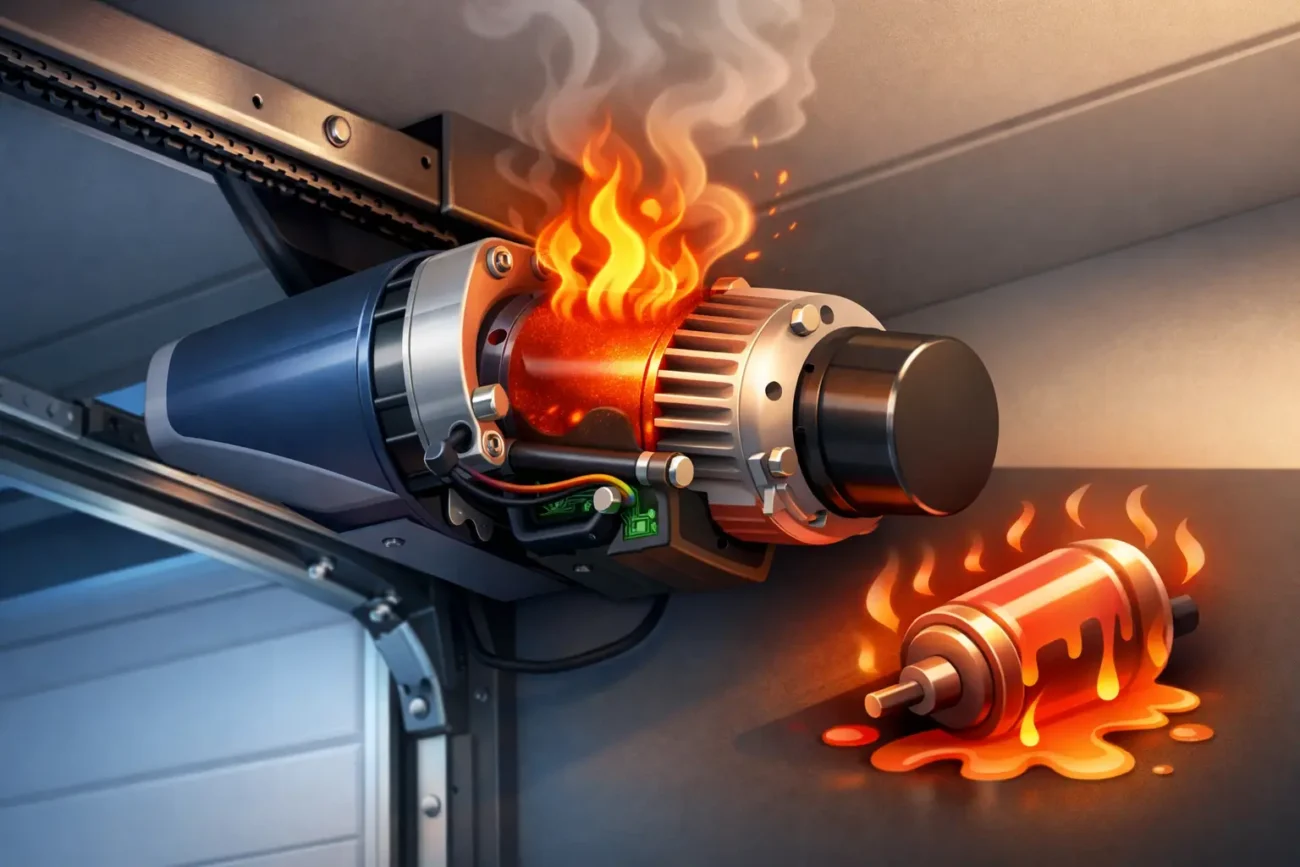
A door motor that feels unusually hot after a few cycles is not something to leave until next week. In automated doors, gates and barriers, heat is often the first visible sign that the motor is working harder than it should. If you are asking what causes door motor overheating, the answer is rarely just the motor itself. More often, it is a symptom of load, power, setup or component issues elsewhere in the system.
That matters because overheating shortens motor life, trips thermal protection, causes intermittent faults and can leave a site with a door stuck open or shut at exactly the wrong time. On a busy industrial entrance or commercial access point, that quickly becomes a safety, security and operational problem.
What causes door motor overheating in real systems?
In practical terms, overheating happens when the motor draws more current than it should, runs for too long without adequate rest, or cannot shed heat effectively. The root cause may be mechanical, electrical or environmental. Sometimes it is a straightforward wear issue. Sometimes it is a mismatch between the motor, the control setup and the workload expected of the door.
A motor is designed to operate within a defined range. If the door is too heavy, the springs are out of balance, the gearbox is tight, or the voltage supply is unstable, the motor compensates by working harder. That extra effort turns into heat. If the system also has a high duty cycle, poor ventilation or repeated start-stop commands, the heat builds faster than it can dissipate.
Excess load is one of the most common causes
When a door becomes harder to move, the motor sees the difference immediately. This is common with roller shutters, sectional doors, sliding gates and automatic pedestrian doors where moving parts wear gradually and the added resistance is not obvious at first.
Worn bearings, seized rollers, misaligned tracks, damaged hinges and stiff guide rails all increase drag. On spring-assisted doors, poor spring balance is another major factor. If the springs are tired or incorrectly tensioned, the motor ends up doing work the counterbalance system should be handling. The result is higher current draw and rising motor temperature.
This is why a motor that has run reliably for years can suddenly begin overheating even though nothing has changed electrically. The motor has not become weaker overnight. The door has simply become more difficult to move.
Poor balance and friction often get missed
Engineers usually check the obvious faults first, but friction and imbalance are still among the biggest causes of repeat overheating. A door may complete its travel, yet still be overloading the motor every time. If opening speed has slowed, travel sounds rough, or the motor housing is too hot to touch comfortably after a short period, mechanical resistance should be high on the list.
Incorrect duty cycle and overuse
Not every motor is built for intensive use. Some operators are intended for occasional residential cycles, while others are rated for busy commercial or industrial traffic. If a motor is installed on a door that opens far more often than its rating allows, overheating is predictable.
This often shows up where site usage has changed. A door originally fitted for light access may now be serving a warehouse route, delivery entrance or shared commercial unit with constant movement. The motor may still function, but it spends too much time running and too little time cooling.
Thermal cut-outs can mask this problem by shutting the motor down before permanent damage occurs. The site then sees intermittent operation and assumes there is a random fault. In reality, the motor is protecting itself from excess heat.
Voltage and power supply problems
Electrical supply issues are another common reason for a hot-running motor. Low voltage is especially problematic because the motor may draw more current to produce the torque needed to move the door. That increased current creates extra heat in the windings.
Single-phase motors can be sensitive to supply quality, especially on sites with long cable runs, undersized cabling or other equipment causing voltage drop. Three-phase motors can overheat if there is phase imbalance, phase loss or poor connections at terminals and isolators. A loose connection increases resistance, and resistance creates heat.
Capacitor faults also matter on motors that rely on them for starting or running. A failing capacitor can leave the motor struggling to start properly, drawing excess current and heating up quickly. The motor may hum, start sluggishly or stall under load.
Controls can contribute too
Overheating is not always a pure power issue. Control faults can keep the motor energised too long, cause repeated reversing, or stop the system from recognising the correct end positions. If the door tries to drive beyond its normal travel, or repeatedly hunts for a position, the motor spends longer under strain than intended.
Limit switch faults, encoder issues, brake problems and incorrect control board settings can all create conditions where the motor works harder than the operator realises.
Environmental and installation factors
Motors fitted in dusty, greasy or poorly ventilated environments often run hotter. Cooling air paths can become restricted, and dirt build-up on the motor body acts like insulation. In food production, workshops and industrial settings, contamination is a genuine factor, not just a housekeeping issue.
Ambient temperature also matters. A motor operating in a hot plant room or exposed area with poor airflow starts with less cooling headroom. Add a few heavy cycles and overheating appears sooner than it would in milder conditions.
Installation quality is part of the picture as well. A motor that is incorrectly sized, poorly mounted or paired with the wrong gearbox ratio may never operate efficiently. It may do the job, but only by running near its limit. That usually ends the same way – excess heat, nuisance trips and shortened service life.
Wear inside the motor or gearbox
Sometimes the motor really is the problem. Bearings wear, insulation degrades, windings weaken and gearboxes lose lubrication or develop internal damage. As internal friction rises, so does heat.
Older motors can continue working while efficiency drops gradually. That makes faults easy to miss until the symptoms become severe. Burning smells, discoloured casing, noisy operation or repeated thermal tripping are all signs that the issue may be internal rather than external.
A worn brake can also keep slight drag on the system, especially in geared operators. That extra resistance may be enough to tip a motor from normal operating temperature into repeated overheating.
What to check before replacing the motor
Replacing the motor without checking the rest of the system can be an expensive mistake. If the root cause is door drag, poor balance or control fault, the new motor will face exactly the same stress.
Start with door movement. If safe to do so and in line with the manufacturer guidance, assess whether the door moves freely and evenly. Listen for tight spots, scraping or hesitation. Check rollers, tracks, hinges, chains, sprockets and springs where relevant.
Then look at the electrical side. Measure supply voltage under load, inspect terminals and connections, and check capacitors, overload settings and phase condition if applicable. Review the control setup, including limits, force settings, dwell times and any fault history on the controller.
If the site has changed usage, compare the real traffic level with the motor rating. That is a common point of mismatch on older installations.
When overheating points to a parts issue
If a motor has been overheating for some time, secondary components may also need attention. Thermal events can affect capacitors, control boards, wiring insulation, brake assemblies and encoder performance. In some cases the real fix is a matched replacement set rather than a single component swap.
This is where accurate identification matters. Door operators vary widely across brands and models, and ordering by appearance alone can lead to the wrong part arriving on site. If the label is worn or the part is obsolete, good photos, measurements and details of the application can save a lot of time. That is often faster than trial and error, especially when the door is already down.
For trade engineers and facilities teams, the aim is simple: fix the cause, not just the symptom. A hot motor is giving you useful information. It is telling you the system is under stress somewhere.
If you deal with the issue early, you may get away with adjustment, servicing or one replacement component. Leave it long enough, and a manageable fault can turn into a motor failure, a damaged control system and avoidable downtime.
A door motor should work hard when needed, not struggle every cycle. When it starts running hot, treat that as a prompt to inspect the whole system properly. That approach usually saves more time than chasing the motor alone, and it gives you a much better chance of getting the exact part you need first time.

Leave a comment