


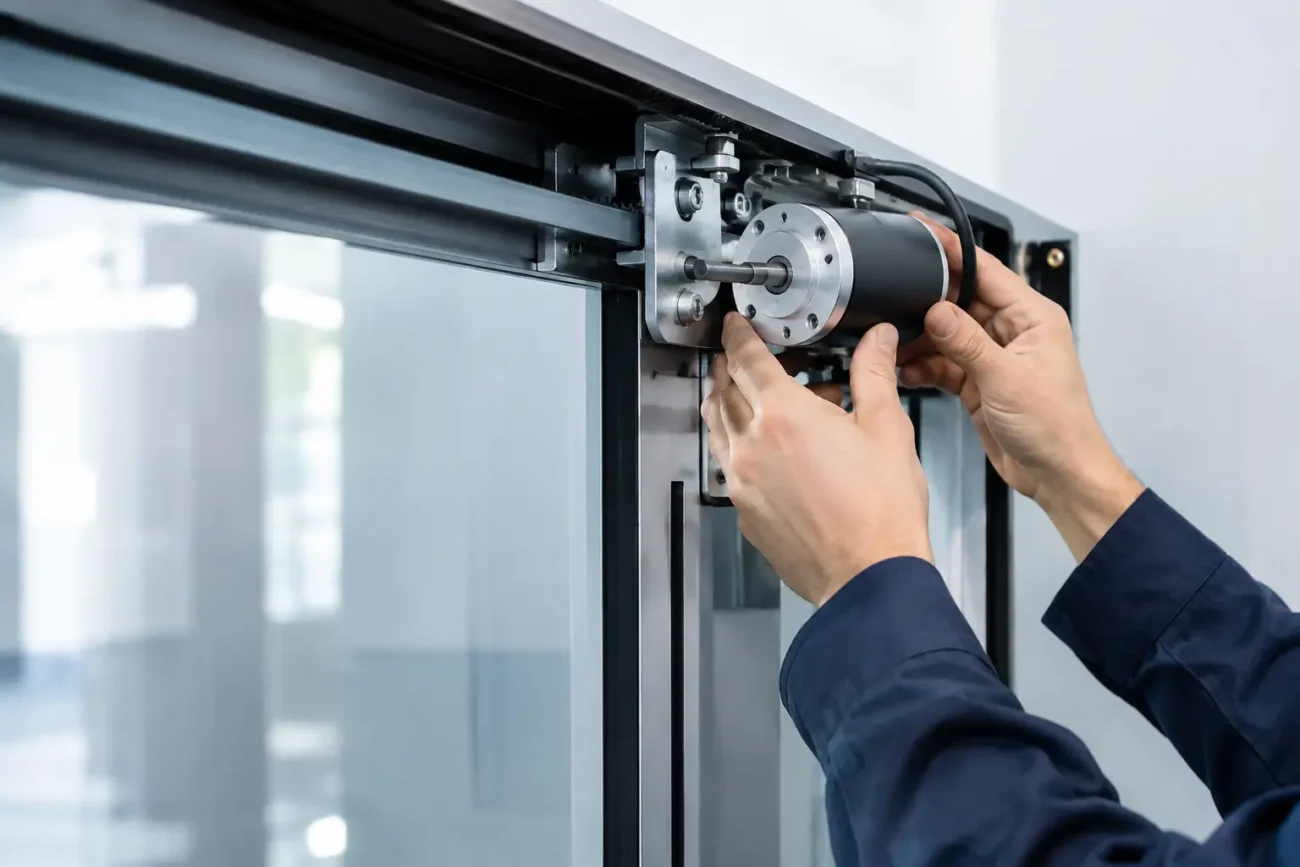
A high-speed door that stops short of the floor, a sectional door that overruns its open position, or an operator that reverses without an obvious obstruction can all point to the same small but critical component. Door encoders provide the control system with the movement data it needs to know where the door is, how fast it is travelling and when it has reached a programmed limit.
For a warehouse, loading bay, car park or commercial entrance, an encoder fault is rarely just an inconvenience. The door may be unavailable, unsafe to use, unable to secure the building properly, or repeatedly causing a call-out. Knowing what an encoder does and how to identify the right replacement helps engineers and site teams avoid changing parts on guesswork.
What door encoders actually do
An encoder measures the rotation of a motor shaft, gearbox shaft or dedicated drive shaft and turns that movement into electrical signals. The controller reads those signals to calculate door position and direction. Rather than relying only on a mechanical limit switch, the operator can monitor movement throughout the opening and closing cycle.
That feedback is used for several jobs at once. It allows the control panel to stop the door at the correct open and closed positions, regulate speed, recognise an unexpected obstruction and detect whether the motor is moving as commanded. On doors with variable-speed drives, accurate feedback is especially important for controlled acceleration and deceleration.
The encoder does not make a door safe on its own. Safety edges, photocells, light curtains, force monitoring and correctly configured controls still have their own roles. But if the position feedback is unreliable, even well-maintained safety equipment can be undermined by erratic door movement.
The main encoder types found on automated doors
The right type depends on the operator and control system. It is not safe to assume that two parts which look similar will communicate in the same way.
Incremental encoders
Incremental encoders produce a series of pulses as the shaft rotates. The controller counts those pulses to track movement. Many use two signal channels, commonly referred to as A and B, which allow the controller to establish direction as well as movement. A third reference or index pulse may also be present.
These are widely used because they are effective and comparatively straightforward. Their limitation is that the controller may need a reference position after power loss, depending on the system design. If pulses are missed because of a damaged cable, loose coupling or electrical interference, the recorded position can drift away from the door’s actual position.
Absolute encoders
Absolute encoders report a specific position value rather than only a pulse count. This can allow an operator to retain position information through a power interruption, provided the system is designed for it. They are common where precise positioning, advanced diagnostics or more complex drive arrangements are required.
Absolute units are not automatically interchangeable with incremental versions. Their output protocol, supply voltage, connector arrangement and programming requirements may be completely different.
Encoders integrated into motors and operators
On many industrial and commercial door systems, the encoder is built into the motor, gearbox or operator assembly. It may not be visible until a cover is removed. Other systems use an external encoder mounted on the end of a shaft, often with a flexible coupling.
This distinction matters when sourcing a part. In some cases the correct repair is a separate encoder. In others, the manufacturer supplies it only as part of a motor, limit assembly or complete operator component.
Symptoms that can indicate an encoder problem
An encoder fault does not always produce the same symptom. The control panel may display a fault code, but on older equipment the evidence can be less direct. A door that runs inconsistently is not necessarily suffering from an encoder issue: mechanical resistance, failing capacitors, brake faults, limit switches, safety inputs and control-board problems can produce similar behaviour.
Common signs worth investigating include:
- The door stops in different positions on successive cycles.
- The operator runs briefly, then stops or reverses with no obstruction present.
- The door opens or closes too far, despite limits appearing to be set correctly.
- The control panel reports an encoder, feedback, rotation or travel error.
- The motor direction is not recognised correctly after work has been carried out.
- The operator will not complete a learn cycle or loses its programmed travel.
Intermittent faults are particularly common where a cable flexes repeatedly, where moisture has entered a connector, or where vibration has loosened a mounting screw or shaft coupling. A failed encoder can be the root cause, but a damaged lead can give exactly the same result.
A practical approach to fault-finding door encoders
Start with the basics before ordering a replacement. Isolate the equipment correctly and follow the door manufacturer’s procedures. Automated doors contain moving parts, stored energy and live electrical circuits, so inspection and testing should be carried out by a competent person.
First, check the fault history and display messages on the control panel. Record the exact wording or code before resetting anything. This information is often more useful than a broad description such as “door not working”, particularly when identifying components for older operators.
Then inspect the physical installation. Look for crushed, stretched or rubbed-through cables; green corrosion in terminals or plugs; moisture inside an enclosure; a loose encoder body; and a coupling that has slipped or cracked. On externally mounted units, make sure the shaft arrangement is secure and aligned. An overtightened or misaligned coupling can damage a replacement encoder quickly.
If the system permits it, compare the controller’s reported position or pulse count with the actual door movement. Electrical testing may confirm whether the encoder has a supply voltage and whether it is producing a signal, but the correct test method depends on the device. Some outputs can be checked with suitable meters or an oscilloscope; others use digital communications that need manufacturer-specific diagnostic tools.
Do not overlook the wider mechanical condition of the door. A binding track, worn roller, damaged curtain, poorly balanced spring system or dragging bottom seal can cause the operator to struggle. The controller may then report a movement-related fault even though the encoder is functioning correctly.
Getting the replacement part right
Matching an encoder by appearance alone is a costly mistake. The number of pulses per revolution, shaft size, mounting style, connector, cable length, voltage, output type and direction requirements all matter. The operator model and control-panel version matter too.
Before removing the old part, take clear photographs of the label, connectors, cable route and mounting arrangement. Note every number on the encoder, motor and controller. If available, record the door manufacturer, operator make, installation age and any displayed error code. For an integrated unit, photographs of the motor label and gearbox can be more useful than a picture of the encoder itself.
Compatibility is not just about whether a plug fits. A unit with the wrong resolution can make the door travel too far or too little. The wrong output signal may prevent movement entirely. A cable with an incorrect pinout can create fault messages or, in the worst case, damage electronics.
This is where specialist sourcing support earns its keep. For discontinued or obscure operators, Door Spares UK Ltd can help identify a suitable part from labels, images and technical details through Ask Dora. That is often faster than replacing a larger assembly simply because the smaller component was not identified correctly.
Installation, setup and commissioning
Once the correct encoder has been fitted, the job is not always finished. Many operators require a fresh learning cycle, limit reset or travel programming process. Follow the manufacturer’s sequence precisely, including any requirements for the door to begin from a fully closed position.
Run several complete cycles while observing travel, stopping points, direction and response to safety devices. Check that the door does not strain at either end of travel and that it reverses or stops correctly when its safety systems are activated. On a busy site, arrange this work around operations where possible, but do not return a door to service until its safety checks are complete.
Keep the removed part and make a record of the final replacement reference. The next fault may be years away, but an accurate maintenance record can turn a long investigation into a quick repair.
Preventing repeat encoder faults
Encoders are usually reliable components, yet their working environment can be unforgiving. Cold stores, washdown areas, dusty workshops, exposed loading bays and high-cycle doors all place extra demands on cables, seals and connectors. Routine inspection should include cable restraint, enclosure integrity and secure mounting, not only the condition of the door leaf or curtain.
Where repeat failures occur, look for the underlying cause. Water ingress, poor cable routing, vibration, electrical noise or a failing gearbox can destroy more than one encoder. Replacing the component without correcting that cause only postpones the next breakdown.
When an automated door starts behaving unpredictably, treat the encoder as part of a wider control and mechanical system. A clear photo, the operator details and the exact symptoms give a specialist far more to work with – and give you the best chance of getting the right part fitted first time.



Leave a comment