


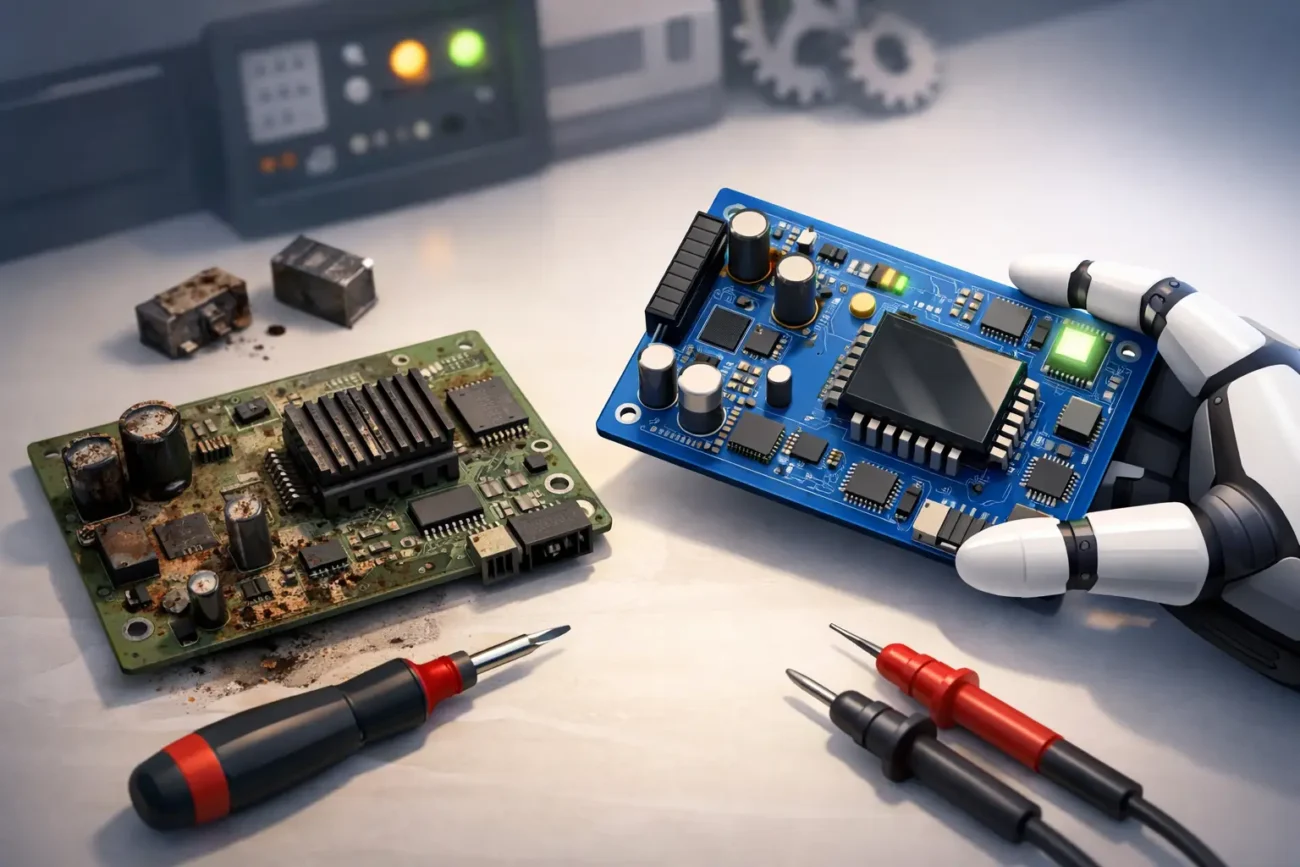
A door starts missing commands, the motor sounds fine, the sensors test out, and yet the system still behaves like it has a mind of its own. That is usually the point when people start asking when to replace control boards. In automated doors, gates and barriers, the control board is the decision-maker. When it starts failing, the symptoms can look like half a dozen other faults, which is why good diagnosis matters before you order parts.
What a control board actually does
The control board manages the logic of the system. It receives inputs from safety edges, photocells, limit switches, encoders, push buttons, keypads and access control devices, then tells the motor and related components what to do. On many systems it also handles timing, force settings, partial opening, auto-close functions and fault reporting.
Because it sits at the centre of the system, a failing board can create faults that appear elsewhere. A shutter may stop short and look like a limit issue. A gate may reverse randomly and look like a safety edge problem. A pedestrian operator may lose settings after a power cut and look like a commissioning fault. Sometimes the board is the problem. Sometimes it is simply reacting to bad inputs.
When to replace control boards instead of repairing around the fault
The first question is not whether the board is faulty. It is whether the board is proven faulty after the rest of the system has been checked properly. A control board should usually be replaced when testing shows consistent failure on the board itself, not when the fault is still being guessed at.
One clear sign is visible damage. Burn marks, blown tracks, swollen capacitors, corroded terminals or signs of moisture ingress are hard to ignore. If the board has taken a surge, overheated, or been exposed to water inside an enclosure, replacement is often more sensible than trying to patch around it.
Another strong indicator is intermittent logic failure. If the power supply is stable, wiring is sound, inputs have been tested, and the unit still behaves unpredictably, the board may be breaking down under load or temperature change. These are the faults that waste hours on site because the system may work during testing and fail again later.
Loss of programming can also point to board failure, especially on older units. If settings repeatedly disappear, relays fail to trigger correctly, or the board no longer stores or executes parameters as it should, replacement is often the cleanest route.
Then there is the practical side. If the board is obsolete, poorly supported or known for recurring faults, repair may not be worth the labour cost or call-back risk. For a site that depends on reliable access, a suspect board can become more expensive than a replacement very quickly.
Faults that can mimic a bad control board
Before deciding when to replace control boards, it pays to rule out the usual suspects. Low voltage issues, damaged motor windings, faulty capacitors, failed encoders, contaminated photocells, broken safety edges and loose terminations can all create board-like symptoms.
Poor earthing and water ingress are common troublemakers as well. A board may appear faulty when the real issue is corrosion in connectors, unstable mains supply or a damaged transformer. On industrial doors in particular, vibration, dust and temperature swings can expose weaknesses elsewhere in the system.
This is where methodical testing matters. Check incoming power, fuses, outputs, input status, safety circuits and motor condition before condemning the board. If the board has diagnostic LEDs or fault codes, use them, but do not rely on them blindly. They help narrow things down, not replace proper fault-finding.
Repair or replace – what makes sense?
There is no single answer because it depends on the application, the age of the equipment and the cost of downtime. In some cases, a replaceable fuse, relay or plug-in module may solve the issue. In others, board-level repair is possible but not commercially sensible, especially if the fault is intermittent or the unit has multiple aged components.
For trade engineers and facilities teams, labour time is usually the deciding factor. If an attempted repair keeps a loading bay out of action for another day, replacement is often the better value option. The same applies to access-critical gates and barriers where unreliable automation affects security as much as convenience.
Older boards also raise compatibility questions. Even if a repair is technically possible, you may still be left with an ageing board paired with worn peripherals and limited manufacturer support. In that situation, replacing the board with the correct part, or in some cases upgrading the control setup, can reduce repeat faults.
Signs a replacement should not be delayed
Some faults move from inconvenient to unsafe. If the board is causing erratic opening and closing, ignoring safety inputs, failing to stop at limits or producing unexplained motor movement, the system should not be left in service while someone hopes it settles down.
On powered doors and gates, unsafe operation is not just a nuisance. It can create risk for staff, visitors, vehicles and goods. A board that no longer responds properly to safety devices, or one that resets unpredictably during operation, should be treated as a priority issue.
Frequent nuisance trips are another warning sign. They may not look dramatic, but repeated false faults often point to a board that is degrading. If call-outs are becoming regular and no external cause has been found, replacement is usually less painful than continued reactive maintenance.
How age and availability affect the decision
A ten-year-old board that has run reliably may still be worth replacing if the exact part is available and the rest of the operator is sound. But if the board is discontinued, the enclosure is tired, and several other components are close to end of life, fitting one last part may not be the smartest use of budget.
Availability matters just as much as age. For many commercial and industrial systems, a fast exact-fit replacement gets the site moving again with minimal disruption. Waiting weeks for a doubtful repair on an obsolete board is rarely appealing when operations are already affected.
This is often where specialist sourcing helps. If you have part numbers, photos of the label, or even just the operator make and model, it is much easier to confirm whether replacement is straightforward or whether a more considered upgrade path is needed.
When to replace control boards on modern systems
Modern boards are more capable, but they are not immune to failure. In fact, systems with more safety devices, access control integrations and programmable features can be harder to diagnose because there are more inputs and more ways for a fault to present itself.
Replace the board on a modern system when testing confirms failed outputs, corrupted programming, communication faults that persist after wiring checks, or physical component damage. Be careful, though. Software settings, paired devices and configuration parameters may need to be transferred or recommissioned correctly after fitting the new board.
That is why matching the exact board version matters. A near match is not always good enough. Differences in firmware, terminal layout or motor logic can create fresh problems even if the board looks similar.
A practical approach before ordering
If you are on site and suspect the board, gather as much detail as possible before sourcing the part. Note the make and model of the operator, take clear photos of the board front and back, record any fault codes, and check for visible damage. It also helps to confirm what has already been tested so you do not replace the board only to find the original fault was elsewhere.
For less technical buyers, a photo-led approach is often enough to get started. A decent image of the board label, enclosure and connected operator can save a lot of back-and-forth and reduce the chance of ordering the wrong part.
Door Spares UK regularly helps customers work through exactly that process, especially when the original part number is worn, missing or no longer obvious from the unit itself.
The real question is reliability
When people ask when to replace control boards, what they usually mean is whether the board can still be trusted. That is the right question. If a board has proven failure, causes repeat downtime, creates unsafe behaviour or no longer justifies the labour spent keeping it alive, replacement is normally the sensible call.
If the fault is still unproven, slow down and test properly. A control board is too central and too expensive to treat as a guess. But once the evidence is there, delaying replacement often costs more than acting decisively.
A reliable automated door system is not built on hope. It is built on correct diagnosis, the right part, and getting the site back to normal without another avoidable call-out next week.

Leave a comment