


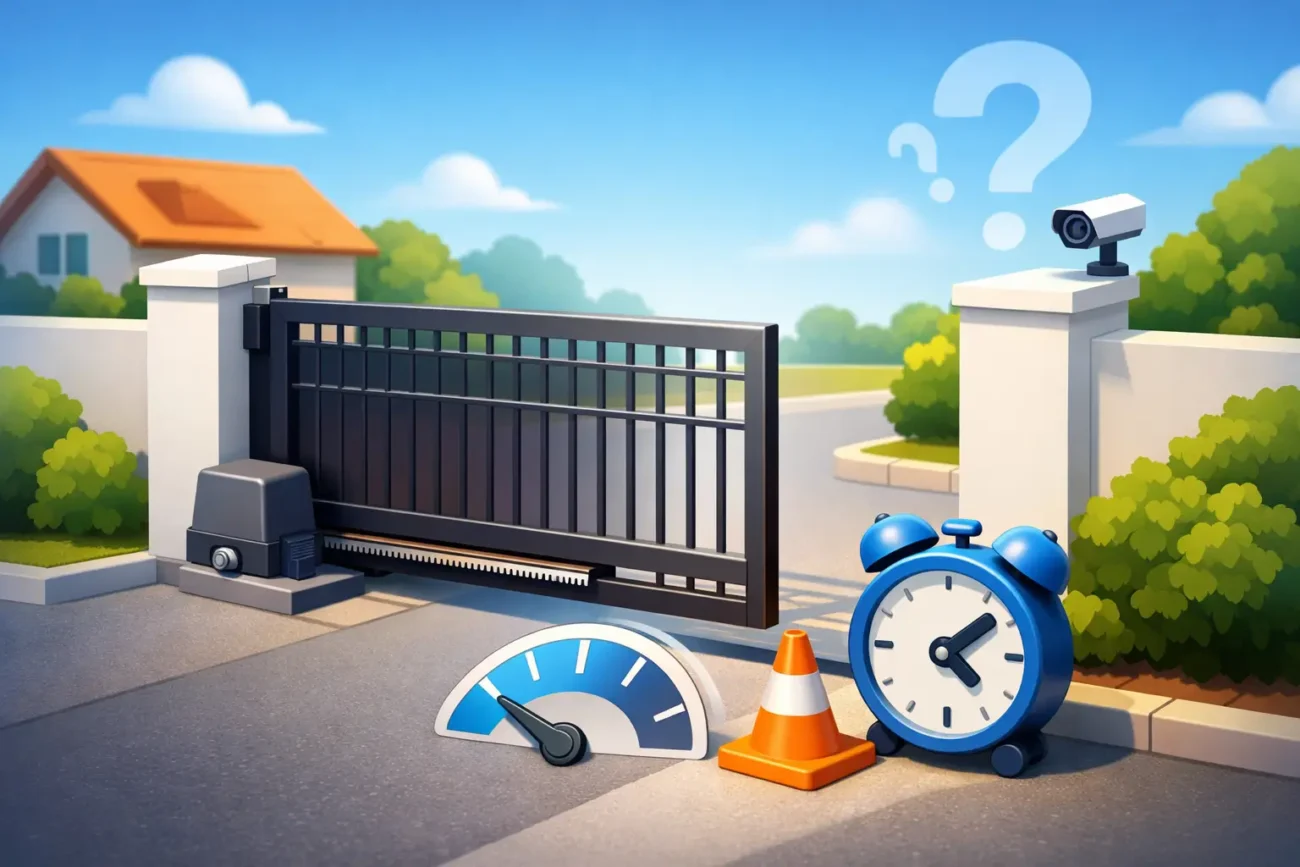
A gate that used to open cleanly in a few seconds but now crawls across the opening is not just an annoyance. If you are asking, why is my gate opening slowly, there is usually a mechanical, electrical or control issue developing in the background – and leaving it too long can turn a simple repair into a failed motor, damaged arm or avoidable call-out.
Slow opening is one of those faults that can mean very different things depending on the gate type. A sliding gate has different weak points from a swing gate, and a domestic setup behaves differently from a commercial entrance with heavy daily traffic. The useful question is not only why the gate is slow, but whether it is struggling under load, being told to move differently, or being held back by a safety or power issue.
Why is my gate opening slowly? Start with what changed
If the gate has always been a little sluggish in winter, that points in a different direction from a gate that became slow overnight. Sudden changes often suggest a failed component, while gradual slowdowns are more likely to be wear, contamination or resistance building up in the system.
Think about the pattern. Is it slow only when opening, or also when closing? Does it hesitate at the start and then pick up, or move slowly the whole way? Is the motor noisier than usual? Those details matter because they help narrow the fault before parts are ordered or settings are altered.
Mechanical resistance is the first thing to rule out
In many cases, a gate opens slowly because the operator is fighting extra resistance. That can come from worn hinges, dry pivot points, damaged rollers, debris in a sliding gate track, misalignment, or even the gate leaf dropping slightly over time.
With swing gates, the motor has to overcome the weight and geometry of the leaf at every cycle. If a hinge is stiff or the gate has started to drag, the opener may still work, but it will labour. You might hear a strained sound, or notice the gate jerking rather than moving smoothly.
With sliding gates, the most common mechanical causes are dirt in the track, worn wheels, a damaged rack, or a gate that is no longer running level. A small amount of resistance can have a big effect on speed, especially on older systems where the motor is already working close to its normal limit.
This is why a proper inspection starts with the gate itself, not the electronics. If the gate does not move freely by hand when safely disengaged, changing boards or remotes will not solve the real problem.
Cold weather and poor lubrication
Weather plays a part, particularly in the UK. Grease can thicken, water can get into moving parts, and debris washed into a track can harden and restrict travel. Not every gate should be heavily lubricated either. Some tracks and roller assemblies need the correct product in the correct quantity, and using the wrong lubricant can attract more dirt and make matters worse.
If the slowdown is more noticeable in colder conditions, that does not always mean the motor is failing. It may mean the system is marginal already, and winter has simply exposed it.
Low voltage and power issues can reduce performance
A gate automation system depends on stable power. If the motor is not receiving the correct voltage, it may still run but with reduced force or inconsistent speed. This is common on systems with ageing power supplies, tired batteries, damaged cabling, poor terminations or control equipment beginning to fail.
On 24V systems, battery backup issues can be a factor. A weak battery may affect operation even when mains power is present, depending on the setup. On mains voltage systems, voltage drop, worn capacitors and motor-related faults can all show up as sluggish movement.
Capacitors are a frequent culprit on single-phase motors. When a capacitor weakens, the motor may struggle to start properly or lose torque under load. To the end user, that often looks like a gate that has become slower, less confident and a bit noisy. It may still complete a cycle for a while, which is why the fault can be missed until it worsens.
Control board settings may be part of it
Not every slow gate is broken. Sometimes the operator has been programmed to move more slowly. Speed, force, soft start, soft stop and obstacle sensitivity settings can all affect opening time.
That said, settings do not usually change on their own. If a gate has slowed after service work, a board replacement, a power interruption or an attempted reset, the programming should be checked. Some systems may default to conservative values after faults or reconfiguration. Others may appear slow because they are spending too long in soft start or slow-down zones.
This is where experience matters. Turning force up without understanding the cause can mask a mechanical problem and create a safety risk. Equally, assuming the board is at fault when the gate is physically binding can lead to unnecessary parts being bought.
Safety devices can hold the gate back
Modern automated gates are designed to react to obstructions and safety inputs. If photocells, safety edges, loop detectors or encoder feedback are giving unstable or incorrect signals, the controller may reduce speed, pause, or move in a guarded way.
For example, if an encoder is failing, the system may lose accurate position or movement feedback. Some operators respond by slowing travel or stopping intermittently. Faulty photocells can also create odd behaviour if the controller thinks there is an obstruction or receives a broken beam signal at the wrong time.
A slow gate that occasionally stops, reverses, or behaves differently in bright sunlight or wet weather may point towards a sensor issue rather than a simple motor problem.
Motors and gearboxes do wear out
If the gate is older or heavily used, internal wear becomes more likely. Motors lose efficiency over time. Gearboxes can develop resistance, noise and backlash. Bearings can deteriorate. These faults do not always produce immediate failure. Often, the first sign is reduced speed and less smooth operation.
Commercial sites tend to see this sooner than light domestic installations simply because the duty cycle is higher. A gate opening dozens or hundreds of times a day will expose weaknesses much faster than one used morning and evening.
The key point is that a worn motor or gearbox should be assessed in context. If the gate mechanics are free and the power supply is sound, but the operator still struggles, the drive unit itself becomes a much stronger suspect.
Why is my gate opening slowly on one side only?
On double swing gates, one leaf can become slower than the other for a very specific reason. It may have a failing arm motor, different hinge wear, a geometry issue at the mounting points, or a control setting affecting one output channel.
This is useful diagnostically because it gives you a comparison. If one leaf is normal and the other is slow, the supply and overall programming may be fine. The issue is more likely local to that motor, arm, hinge line or wiring run.
If both leaves are equally slow, look more closely at shared causes such as voltage, board settings or environmental conditions.
What you can check before calling for parts
There is a sensible middle ground between ignoring the fault and stripping the system apart. First, check whether the gate path is clear and whether there is visible damage, dragging or contamination. Listen to the operator during a full cycle. Look for loose brackets, worn racks, stiff hinges and signs of water ingress in enclosures.
If the system can be safely disengaged in line with the manufacturer instructions, see whether the gate moves freely by hand. If it does not, deal with that first. If it moves well manually but is still slow under power, the focus shifts towards the motor, capacitor, control board, safety devices or power supply.
Avoid guessing with critical components. Automated gates are safety systems, not just convenience products. Randomly adjusting force settings or bypassing devices to test a theory can create more trouble than it solves.
When replacement parts are the real answer
Some faults can be corrected with adjustment, cleaning or maintenance. Others need the right replacement part, and getting that part right matters. A capacitor with the wrong rating, an incompatible control board, a mismatched encoder or a generic photocell that does not suit the original setup can waste time and keep the gate unreliable.
This is where clear identification helps. A photo of the motor label, control panel, existing component and gate layout can speed things up significantly. On older systems, especially where branding has changed or original documentation is missing, part matching can take a bit of detective work.
For engineers, site teams and property owners, the quickest route is often to treat slow operation as an early warning rather than a minor inconvenience. If the gate is already labouring, every cycle adds stress to the system.
If you are not sure why your gate is opening slowly, focus on the basics first: free movement, clean travel path, sound power supply and stable safety inputs. After that, it becomes a parts and diagnostics job. And if the exact component is not obvious, that is the point where proper technical support saves time, especially when the gate in question needs to be back to safe, reliable operation without guesswork.




Leave a comment