


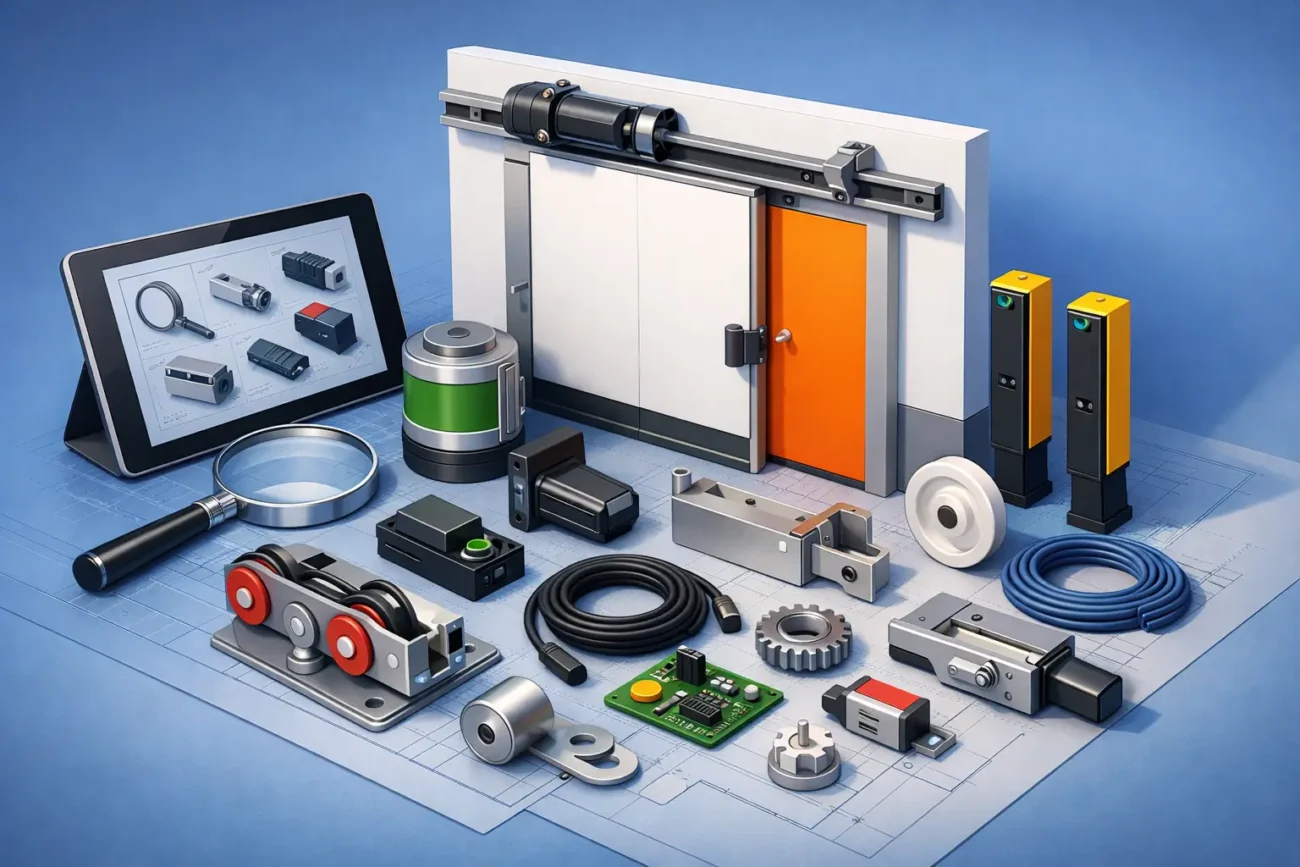
When a Dan Door stops working properly, the fault is often only half the problem. The other half is Dan Door spare identification – working out exactly which motor, control board, encoder, sensor or safety component you need before time and money are wasted on the wrong part. On a busy site, that matters. A cold store, loading bay or industrial entrance does not stay out of service for long without consequences.
Dan Door systems are built for demanding environments, and many are fitted in applications where reliability is non-negotiable. That also means spare parts need to be matched carefully. A part that looks close enough on a screen is not always electrically, mechanically or functionally correct once it reaches site.
Why Dan Door spare identification matters
The biggest mistake with replacement parts is assuming the door brand alone is enough. It rarely is. Dan Door has used different operators, controls and safety devices across different door types and production periods, and some systems may also have had upgrades or repairs over time. Two doors on the same site can carry the same brand badge and still require different spares.
Get identification right and you reduce downtime, avoid repeat visits, and protect the rest of the system. Get it wrong and the costs stack up quickly – extra labour, delayed reopening, possible damage to adjoining components, and frustration for everyone involved.
This is especially true with control components. A failed board or encoder is not a guessing game. Connector layout, voltage, firmware compatibility and application type all need to line up. The same goes for safety edges, photocells and limit devices, where the wrong choice can stop a door from operating safely even if it powers up.
Start with the door, not the failed part
Good Dan Door spare identification usually starts with the complete system. Engineers in a rush often begin with the broken item in hand, but that can lead you down the wrong path if the component has already been replaced once before.
Start by checking the door nameplate or serial data if it is available. Record the model, serial number, manufacturing details and any information on the operator or control panel. Then look at how the door is used. Is it a high-speed fabric door, an insulated industrial door, a freezer application or a specialist hygienic installation? The operating environment gives useful clues because certain parts are more common on specific door configurations.
Photos help far more than most people expect. A clear image of the overall door, the motor, the controller label, wiring terminals and any sensor markings can save a lot of back-and-forth. If a part number has faded or a label is damaged, the housing shape, connector arrangement and mounting style often narrow it down.
The parts that most often need accurate identification
Some components are straightforward. Others are where mistakes happen.
Motors and gearboxes
Motor and gearbox assemblies need more than a visual match. Power rating, duty cycle, shaft configuration, brake arrangement and mounting pattern all matter. If the site has a replacement motor fitted in the past, the original door specification may no longer tell the full story.
A motor that physically fits but runs at the wrong speed or torque can create new faults. Slow cycling, overloading, poor limit accuracy and premature wear are common results.
Control boards and panels
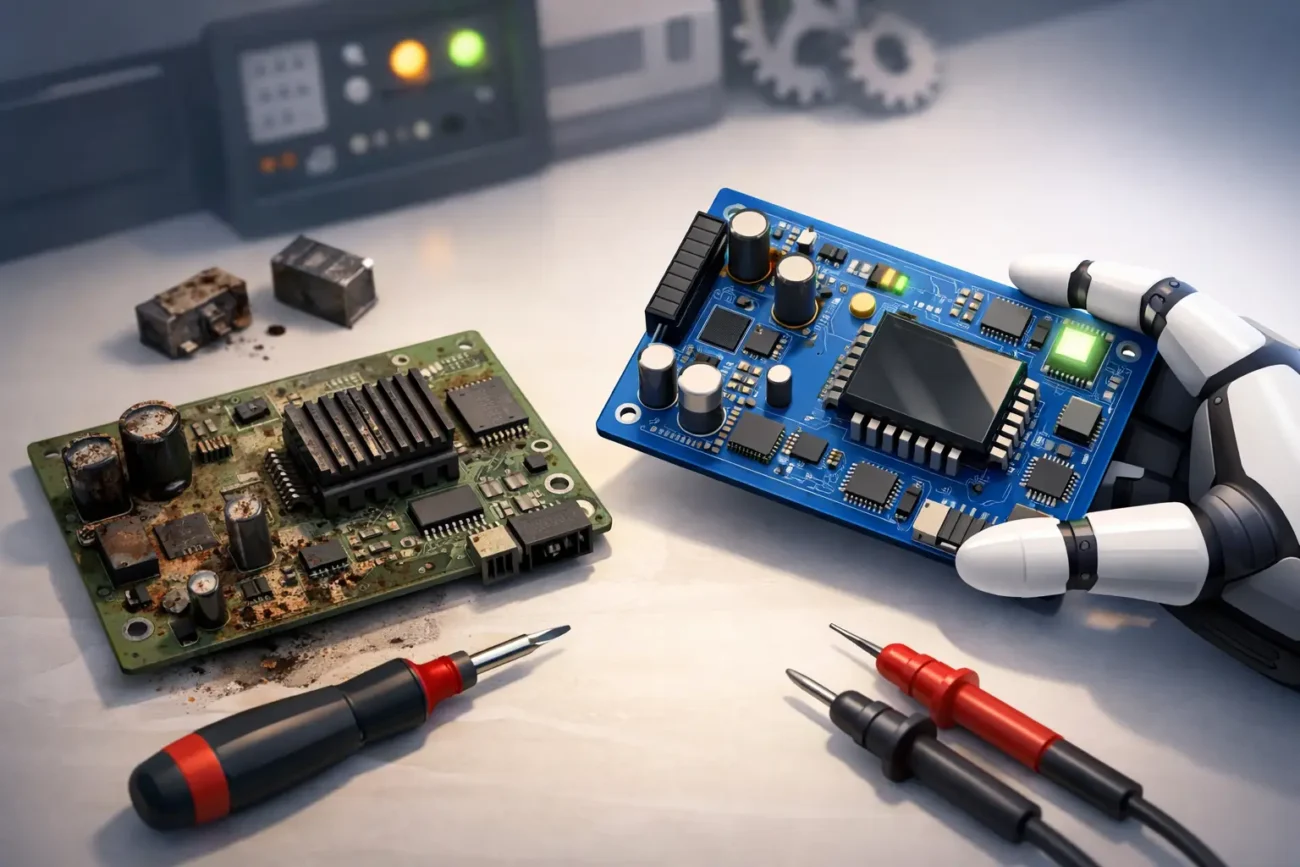
These are among the most commonly misidentified Dan Door spares. Board layout may appear similar across versions, but small differences in inputs, outputs or programming can make one board unsuitable. Product codes, software revisions and enclosure details all need checking.
If the board is burnt out or unreadable, the wider controller assembly and connected accessories can still provide clues. In many cases, the exact panel model is more useful than the damaged board alone.
Encoders and limit devices
Encoders are critical to door position and safe movement. The challenge is that they can vary by pulse type, connector format, mounting arrangement and compatibility with the control system. The wrong encoder may not communicate properly even if it looks right.
Limit switches and position devices also need careful matching. Similar-looking units can have different switching logic or travel ranges.
Safety sensors and edges
Photocells, light curtains and safety edges are not generic just because they serve the same purpose. Operating range, output type, profile dimensions and resistance values all need confirmation. Safety devices should never be selected on guesswork.
What information helps identify the correct spare
The fastest way to sort Dan Door spare identification is to gather a short set of practical details before ordering. Usually that means the door model or serial reference, part numbers from any labels, photos of the component in place, and a note of the fault.
It also helps to mention whether the part is original, whether any previous repair work has been carried out, and whether the door is in a chilled, wet, dusty or high-traffic environment. Those details can affect part selection, especially where upgraded or alternative versions exist.
If you do not know the part name, that is not a problem. A good supplier would rather receive accurate photos and a clear description than a confident but incorrect guess. “Motor on the left side with a square brake housing” is often more useful than a part number copied from the wrong item.
Common reasons identification goes wrong
One issue is assuming the visible component is original to the door. Over the years, many industrial doors are repaired using whatever was available fastest at the time. That can leave a Dan Door running with mixed-generation parts or third-party replacements.
Another problem is relying on old paperwork. Site manuals are useful, but they are not always current. A control panel may have been upgraded, a safety device changed to meet newer requirements, or a damaged motor swapped for an alternative specification.
Wear and environmental exposure also make labels hard to read. In freezer, washdown or heavy industrial settings, stickers and print markings do not stay perfect forever. That is why visual identification and system-level checks are so important.
When a like-for-like spare is not the only option
There are cases where the exact original Dan Door spare is the right answer, and there are cases where an updated replacement makes more sense. That depends on availability, compatibility, lead time and the condition of the wider system.
For example, if an older sensor or control component has been superseded, fitting the newer approved version may be the better route. On the other hand, using an alternative without checking interfaces, safety requirements and programming needs can create more work than it saves.
This is where practical support matters. The best answer is not always the part that matches a photo most closely. It is the part that gets the door back into safe, dependable service without causing another call-out next week.
A sensible approach on urgent jobs
When the site is under pressure, there is a temptation to order fast and check later. That is understandable, but expensive. A better approach is to pause for ten minutes and collect enough evidence to identify the spare properly.
Take wide and close-up photos. Capture every label. Note any fault code on the controller. Record what the door does and does not do – no movement, partial travel, intermittent stopping, safety trip, motor hum, burnt board, damaged cable. Those symptoms help narrow down whether the failed part is genuinely the root cause.
If you are unsure, asking for technical help early usually saves time. That is especially true for facilities teams or property owners who may not deal with industrial door components every day. Even experienced engineers use part-finding support when a system has been modified or the identification plate is missing.
For hard-to-find items, a specialist supplier with real product knowledge can often spot details that are easy to miss. That is the difference between simply selling parts and helping get the right part first time. At Door Spares UK Ltd, that is exactly where Ask Dora can make the process easier.
Dan Door spare identification is really about reducing risk
At face value, identification sounds like an admin job. On site, it is risk control. The right part keeps operations moving, maintains safety performance and avoids wasted labour. The wrong one can leave a shutter, rapid roll door or industrial entrance out of action for another day, or longer.
That is why clear photos, serial details and a proper check of the full system are worth the effort. Whether you are an engineer trying to finish a repair, a facilities manager trying to minimise disruption, or a site owner trying to avoid repeat failures, accuracy pays for itself quickly.
If you are stuck, the best next step is not to guess. It is to identify the door properly, verify the component carefully, and treat the spare as part of the whole system rather than a standalone item. That approach usually gets the door running again faster, and with fewer surprises once the job starts.

Leave a comment